
The Dolomites are a mountain range in north-eastern Italy, part of the Southern Limestone Alps. They stretch from the River Adige in the west to the Piave Valley in the east, with the Puster Valley and Val Sugana marking their northern and southern edges. The range is split almost evenly between Belluno, South Tyrol, and Trentino.
Stories from Dolomites
9 stories


About Dolomites
| Essential fact | Detail |
|---|---|
| Type | Mountain range |
| Location | North-eastern Italy |
| Geologic setting | Southern Limestone Alps |
| Main provinces | Belluno, South Tyrol, Trentino |
| Boundaries | River Adige, Piave Valley, Puster Valley, Val Sugana |
Read the full overviewWhy the Dolomites look so distinct, How did the Dolomites form?, Why do designers and photographers keep returning there?, What does the Dolomites setting look like in practice?
Why the Dolomites look so distinct
The Dolomites are named for dolomite, the calcium magnesium carbonate rock that gives many of their peaks a pale, hard-edged appearance. Their vertical walls, narrow ridgelines, and jagged towers differ from the rounded forms often associated with other Alpine ranges. The light rock surface catches sunrise and sunset with a pink-grey glow known as enrosadira, a visual effect that has made the range especially recognizable in photography and landscape art.
That rocky character matters in practice. The mountains are not only scenic backdrops; they shape building methods, routes, and materials in the region. Stone, timber, glass, and steel structures there often respond to steep slopes, severe winters, and wide views, creating architecture that frames the landscape rather than competes with it.
How did the Dolomites form?
The range emerged from ancient marine sediment that was uplifted and folded over millions of years. Much of the rock began as tropical reef material in a shallow sea, then became part of the Alpine mountain-building process. That origin explains why limestone and dolomite dominate the geology, and why cliff faces can appear sharply stratified and fractured.
Glacial erosion later sharpened the forms even further. Ice carved passes, valleys, and basins, leaving isolated spires and massive walls behind. For makers working in or inspired by the region, that geology is more than background information: it influences local quarrying traditions, the availability of stone, and the dramatic visual language used in photography, tourism, and design.
Why do designers and photographers keep returning there?
The Dolomites offer a rare combination of strong topography and clean light. Photographers value the clear air, long shadows, and abrupt weather shifts that produce high contrast and saturated colour. Landscape images from the area often emphasize negative space, rock texture, and the tension between natural mass and open sky.
Architects and designers are drawn to the same qualities. Hotels, shelters, viewing platforms, and private houses in the Dolomites often use large panes of glass, simple timber framing, and compact volumes to reduce visual bulk. The result is a region where built form is often judged by how quietly it sits within the terrain.
What does the Dolomites setting look like in practice?
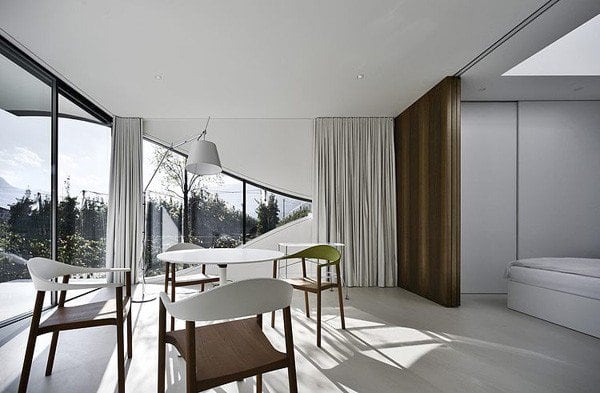
In articles about the Dolomites, the setting usually appears through specific material contrasts: timber cabins against pale rock, reflective glass set into a snowfield, or infrared imagery that turns the landscape into red and silver tones. These visual approaches highlight how the mountains read differently depending on medium. A black-and-white photograph stresses structure; an infrared image reverses expectations of warmth and cold; an interior view uses the mountains as a moving backdrop.
The range also functions as a destination shaped by circulation and access. Roads, passes, ski routes, and cable systems thread through the valleys, while settlements cluster in protected basins. That combination of remote scale and engineered access makes the Dolomites a recurring subject in travel writing, architecture features, and visual culture.
Frequently Asked Questions
Are the Dolomites the same as the Alps?
No. The Dolomites are one range within the Alps, specifically part of the Southern Limestone Alps. The Alps cover a much larger mountain system across several countries, while the Dolomites refer to a distinct area in north-eastern Italy.
Why are the Dolomites famous in design and photography?
The range has sharply defined peaks, pale rock, and clear atmospheric light that create strong visual contrast. Those conditions suit landscape photography and also influence architecture, where buildings often use restrained forms and transparent materials to keep attention on the mountains.
What is the best-known visual effect associated with the Dolomites?
The best-known effect is enrosadira, when the rock takes on pink, orange, or violet tones at sunrise and sunset. The effect comes from the way light strikes the mineral surface and the surrounding atmosphere. It is one reason the Dolomites have such a distinctive presence in photographs and travel imagery.