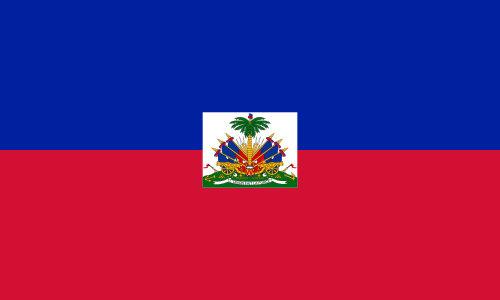
Haiti is a Caribbean country occupying the western third of the island of Hispaniola, which it shares with the Dominican Republic. Its capital is Port-au-Prince. The name comes from Ayiti, the Taíno word for “land of high mountains,” a reminder that steep terrain, dense settlement, and political life have long shaped the country’s history.
- Haiti is the western part of Hispaniola, in the Greater Antilles.
- Its name comes from the Taíno language and refers to mountainous land.
- The landscape includes high ridges, coastal plains, and a vulnerable shoreline.
- Haitian culture has had a major influence on Caribbean art, music, religion, and political thought.
- Environmental damage, poverty, and repeated political crises affect daily life and infrastructure.
Where is Haiti, and what is its landscape like?
Haiti sits in the Caribbean Sea, east of Cuba and west of Puerto Rico, on the island it shares with the Dominican Republic. Much of the country is mountainous, with narrow valleys and limited flat land for large-scale agriculture and urban expansion. Pic la Selle, the highest point, rises to 2,680 metres and reflects the kind of rugged interior that has shaped settlement patterns for centuries.
The geography matters because it affects transport, farming, and construction. Roads can be difficult to maintain, soils erode quickly when forests are cleared, and communities often live close to coasts or along hillsides exposed to storms and landslides. Haiti’s built environment, from small houses to public infrastructure, is often designed in response to heat, flooding, and the practical constraints of a steep island terrain.
How did Haiti get its name?
Before European colonisation, the Taíno people called the island Ayiti, meaning “land of high mountains.” That original name survived in modified form as Haiti and remains central to the country’s identity. It connects the modern state to an older indigenous geography, even though colonisation, slavery, and plantation economies transformed the island profoundly.
Under French rule, the western part of Hispaniola became Saint-Domingue, one of the richest colonies in the Atlantic world because of sugar and coffee production based on enslaved labour. The Haitian Revolution, beginning in 1791, overthrew that system and led to independence in 1804. Haiti became the first Black republic and the first nation born from a successful slave revolt, a fact that still shapes how the country is understood politically and culturally.
What does Haiti mean in art and visual culture?
Haiti has a powerful visual identity formed by painting, sculpture, textiles, religious objects, murals, and street imagery. Haitian art is often associated with vivid colour, flattened perspective, symbolic scenes, and direct references to Vodou, everyday labour, domestic life, and the natural world. These forms are not simply decorative; they carry memory, religious meaning, and social commentary.
The country’s visual culture also appears in public art and civic space. Murals, painted boats, sign painting, and handmade objects often serve practical as well as aesthetic purposes, especially where resources are limited. A fishing boat painted in bright patterns can be both working equipment and a public image of local identity, turning material need into a visible graphic language.
Why does Haiti matter now?
Haiti matters because it remains central to discussions of postcolonial history, racial politics, migration, and resilience under pressure. It has experienced political instability, economic hardship, earthquakes, hurricanes, and long-term infrastructure strain, yet Haitian makers continue to build cultural forms with strong local force. Music, painting, fashion, ritual objects, and community craft all carry that history forward.
For readers of visual culture, Haiti is important not only as a place of crisis but as a site of invention. Designers, photographers, and artists often look there for examples of adaptation: low-cost materials used with precision, bright surfaces applied to utilitarian objects, and shared visual codes that turn ordinary things into signs of collective life. Its influence is visible far beyond the island, especially in the Caribbean diaspora and in the global history of Black modernity.
Frequently Asked Questions
Is Haiti the same as Hispaniola?
No. Hispaniola is the island, and Haiti occupies its western side. The eastern side is the Dominican Republic. The two countries share the island but have different colonial histories, languages, and political trajectories.
Why is Haiti often discussed in relation to art and design?
Haiti has a strong tradition of expressive, resourceful making, especially in painting, sculpture, and public-facing craft. Haitian artists and makers frequently work with found materials, religious iconography, and bold colour to create forms that are both practical and symbolic. That combination has attracted attention from artists, photographers, and designers working beyond Haiti as well.
What is the significance of the Haitian Revolution?
The Haitian Revolution ended slavery in the colony of Saint-Domingue and led to independence in 1804. It was one of the most important anti-colonial revolutions in modern history and the only one to create a state founded by formerly enslaved people. Its legacy shapes Haiti’s political identity and global historical importance.
}
At a glance
- Address
- Haiti
- Coordinates
- 18.533333, -72.333336
Articles mentioning Haiti