Nepal is a landlocked country in South Asia, set high in the Himalayas between China to the north and India on three sides. Its capital, Kathmandu, sits in a valley that has long been a centre of trade, religion, and craft. Nepal matters in visual culture because its landscapes, festivals, and built environments shape photography, documentary work, and design, while its workshops produce some of the region’s most recognisable handmade goods.
| Fact | Detail |
|---|---|
| Official name | Federal Democratic Republic of Nepal |
| Region | South Asia |
| Capital | Kathmandu |
| Land borders | China and India |
| Geography | Himalayan mountains, river valleys, and hill districts |
| Best known for | Mountains, pilgrimage sites, festivals, and craft traditions |
Where is Nepal, and what does that geography mean?
Nepal occupies a narrow but dramatically varied strip of land in the central Himalayas. The country rises from lowland plains in the south to some of the highest peaks on Earth, including Mount Everest on the border with China. That vertical geography creates sharp changes in climate, settlement, transport, and building type over short distances.
Because Nepal has no seacoast, roads, air routes, and cross-border trade carry major importance. In the mountains, movement often depends on footpaths, suspension bridges, pack animals, and small aircraft. In the Kathmandu Valley and other urban centres, dense neighbourhoods, temples, courtyards, and markets create a built environment shaped by centuries of local masonry, carpentry, and metalwork.
Why Nepal matters in art, design, and photography
Nepal appears often in documentary and travel photography because its visual contrasts are strong and immediate: prayer flags against snow, brick shrines beside traffic, festival crowds packed into narrow streets, and terraced hills under changing weather. Kathmandu, in particular, offers layered scenes where ancient religious architecture sits next to contemporary urban life. That mix gives photographers and filmmakers a place where ritual and everyday routine remain visible in the same frame.
The country also matters because of the way craft survives in daily use. Wood carving, repoussé metalwork, handwoven textiles, thangka painting, and clay brick construction all remain visible in temples, houses, shops, and workshops. These are not museum forms only; they continue to shape the appearance of streets, interiors, garments, and devotional objects.
What does Nepal look like in practice?
In practical terms, Nepal is a country of distinct local textures. In the Kathmandu Valley, red brick, carved timber windows, gilded shrine roofs, and stone pavements define older neighbourhoods. In hill towns, slate roofs, narrow lanes, and steep agricultural terraces dominate. In the high Himalaya, buildings become simpler and more weatherproof, using stone, timber, and compact forms that respond to cold, wind, and remoteness.
Festivals are equally important to Nepal’s visual identity. Holi turns city streets and courtyards into fields of colour. Processions for Indra Jatra, Dashain, and Tihar bring masks, music, lamps, animal sacrifice, masks, chariots, and ritual objects into public view. For editors, photographers, and designers, Nepal offers not one fixed image but a repeating rhythm of season, ceremony, and material culture.
How did Nepal become important historically?
Nepal’s historical importance comes from its position between the Tibetan plateau and the Indian plains. For centuries, the Kathmandu Valley linked trade routes, religious networks, and artistic exchange across South Asia and the Himalayas. Newar artisans in particular developed a strong urban craft tradition in wood, stone, metal, and painting that still shapes the region’s visual language.
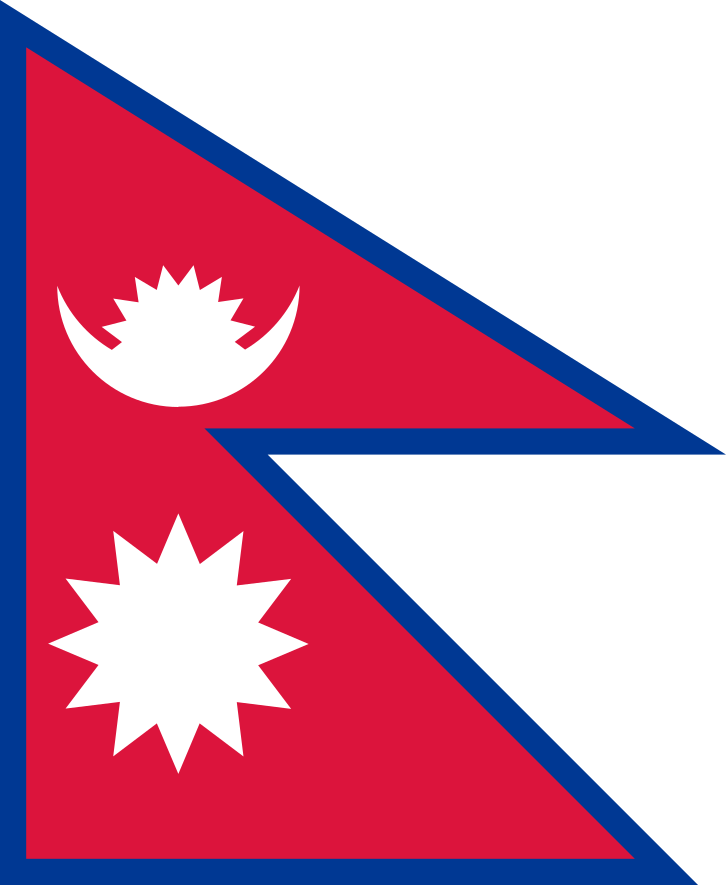
Modern Nepal emerged as a unified state in the 18th century, later navigating monarchy, political upheaval, civil conflict, and democratic reform. Today it remains a sovereign republic whose identity is formed by both national symbols and local differences in language, religion, and building practice. Those layers help explain why the country appears so often in work about place, resilience, migration, and landscape.
Frequently Asked Questions
Is Nepal part of the Himalayas?
Yes. Much of Nepal lies within the Himalayan mountain system, and the country contains lowland, mid-hill, and high-mountain zones. That range gives Nepal an exceptional variety of environments within a relatively small territory.
What crafts is Nepal known for?
Nepal is known for wood carving, metal repoussé, stone carving, weaving, and religious painting, especially in and around the Kathmandu Valley. These crafts appear in temples, household objects, clothing, and public architecture. They remain central to how many Nepali towns and cities look and feel.
Why do photographers often work in Nepal?
Photographers are drawn to Nepal because it offers strong visual contrast: mountains, dense urban heritage, ritual life, and daily labour all sit close together. The country also has highly recognisable moments of colour and movement, especially during festivals. Those conditions make it a rich place for documentary and cultural photography.
At a glance
- Address
- Nepal
- Coordinates
- 26.533333, 85.316666
Articles mentioning Nepal