Mount Everest is the highest mountain on Earth, rising to 8,848.86 meters above sea level on the border between Nepal and China. It sits in the Mahalangur Himal, part of the central Himalayas, and its summit marks one of the best-known points on the planet. For climbers, photographers, and brand campaigns alike, Everest stands for extreme altitude, physical risk, and the visual shorthand of “the top.”
- Highest point above sea level on Earth, with the summit straddling Nepal and Tibet.
- Part of a larger massif that includes Lhotse, Nuptse, and Changtse.
- Formed by the collision of the Indian and Eurasian tectonic plates.
- Known locally by names such as Sagarmatha in Nepali and Chomolungma in Tibetan.
- Its fame comes as much from expedition history and photography as from geography.
Where is Mount Everest?
Everest lies in the Mahalangur Himal, a high section of the greater Himalayas that also contains some of the planet’s tallest neighboring peaks. The summit sits directly on the international border, with Nepal to the south and the Tibet Autonomous Region of China to the north. That border crossing at the crown of the mountain gives Everest a rare political as well as geographic profile.
The mountain is part of a massif rather than a lone peak. Lhotse is its most prominent neighbor, separated by the South Col, while Nuptse and Changtse frame the same high-altitude landscape. In photographs and maps, Everest often appears as part of a serrated ridge system rather than a single isolated cone.
Why does Everest matter?
Everest matters because it defines a limit. It became the standard by which the world measures high altitude, severe weather, and the machinery of mountaineering. Since the first British-led survey in the 19th century and the later naming of the mountain after surveyor George Everest, it has held a special place in global geography and expedition culture.
Its summit has also become a symbol used far beyond alpinism. Designers, advertisers, travel editors, and museum curators invoke Everest when they want to signal difficulty, endurance, and scale. That symbolic power depends on a material reality: thin air, deep snow, exposed rock, and temperatures that can destroy equipment and human bodies alike.
What does climbing Everest involve?
Modern ascents rely on fixed ropes, ladders over crevasses, oxygen systems, high-altitude tents, and long logistical supply chains. Expedition teams move through the Khumbu Icefall or the North Col route, establish camps at progressively higher elevations, and wait for short weather windows. Above 8,000 meters, the so-called death zone makes every movement slower and more dangerous because the body cannot recover properly.
The climb has changed as access has widened, but the mountain itself still controls the terms. Weather, avalanche risk, frostbite, and altitude sickness shape every decision. Sherpa guides and high-altitude workers have made the modern climbing economy possible, carrying loads, fixing lines, and managing camps with skills built over generations in Himalayan conditions.
What does Everest look like in practice?
Everest is not a neat pyramid from every angle. Its northern face rises as a broad wall of rock and ice; the south side drops toward the Western Cwm and the South Col; glacier systems break the mountain into ledges, seracs, and hanging ice. In clear conditions, the summit can appear deceptively clean in photographs, but the route to it is a technical corridor through unstable terrain.
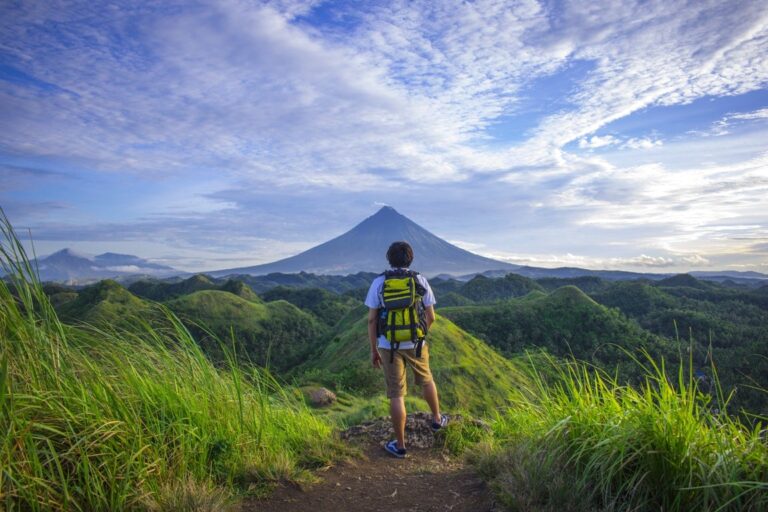
In visual culture, Everest often arrives through three kinds of image: expedition photography, travel panoramas, and product imagery that borrows the mountain’s authority. A phone accessory, a jacket, or a coffee campaign set against Everest uses the mountain as a signal of resilience. The landscape is so recognizable that it can stand in for adventure itself, even when the actual climb remains out of frame.
Frequently Asked Questions
Is Everest the tallest mountain in the world?
Yes, if height is measured from sea level, Everest is the tallest mountain on Earth. If the measurement starts at the center of the planet, some mountains on the equator are slightly farther from the center because Earth bulges there. That distinction does not change Everest’s status as the highest point above sea level.
What are the local names for Everest?
In Nepali, the mountain is commonly called Sagarmatha. In Tibetan, it is known as Chomolungma. The English name “Everest” came from British surveying in the 19th century and honors George Everest, although he did not name the mountain himself.
Why is Everest so hard to climb?
Altitude is the main reason. At summit height, the air holds too little oxygen for the body to function normally, so climbers often use supplemental oxygen, and even then they move slowly and recover poorly. Add sudden storms, avalanche-prone slopes, and long exposure to cold, and the mountain becomes one of the most demanding environments on Earth.
At a glance
- Address
- Solukhumbu District, Nepal
- Coordinates
- 27.988056, 86.92528
Articles mentioning Mount Everest