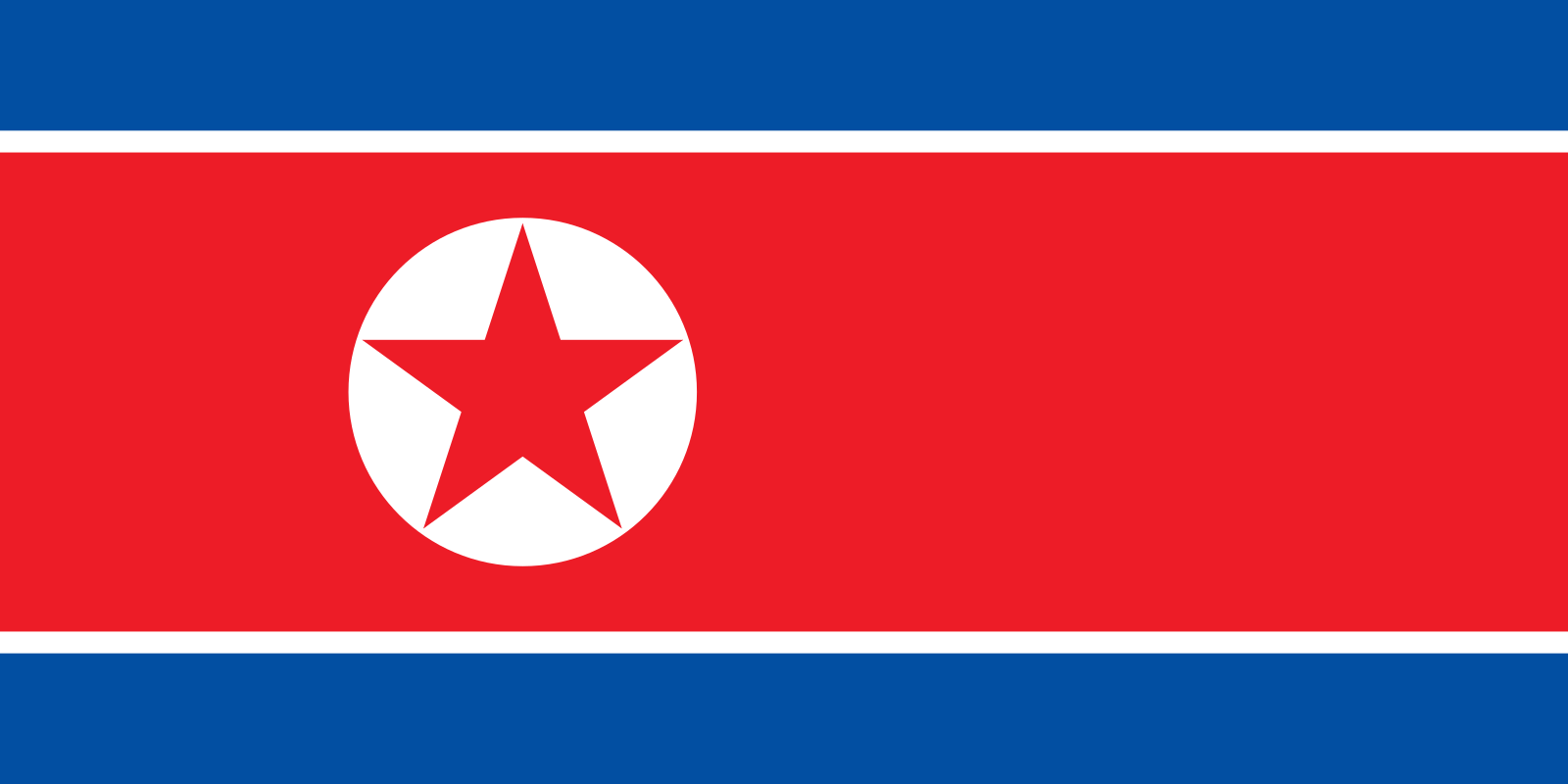
North Korea is the Democratic People’s Republic of Korea, a state in East Asia that occupies the northern half of the Korean Peninsula. Its capital is Pyongyang, and its borders with China are formed largely by the Amnok and Tumen rivers. The country is known for a tightly controlled political system, a heavily managed public image, and an architecture and visual culture shaped by state ideology and isolation.
- A sovereign state in East Asia, officially the Democratic People’s Republic of Korea.
- Capital: Pyongyang, also its largest city.
- Bordered by China to the north, and by South Korea along the Korean Demilitarized Zone.
- Its built environment is marked by monumental state architecture, civic squares, and symbolic urban planning.
- Much of what is seen abroad comes through photography, reportage, and official imagery rather than open cultural exchange.
Where is North Korea, and how is it defined?
North Korea sits in the northern portion of the Korean Peninsula, with the Sea of Japan to the east and the Yellow Sea to the west. It emerged from the division of Korea after Japan’s defeat in 1945, when Soviet and American occupation zones hardened into two separate states. The Korean War, fought from 1950 to 1953, fixed that division in place and left the peninsula split by one of the most militarised borders in the world.
Geography matters here because it helps explain both the country’s strategic isolation and its visual character. Mountain ranges cover much of the land, while the capital plain around Pyongyang has been developed as a stage for state power. Rivers, rail lines, military sites, and planned districts all reflect a state that has long treated territory as something to be organised, watched, and displayed.
What does North Korea look like in practice?
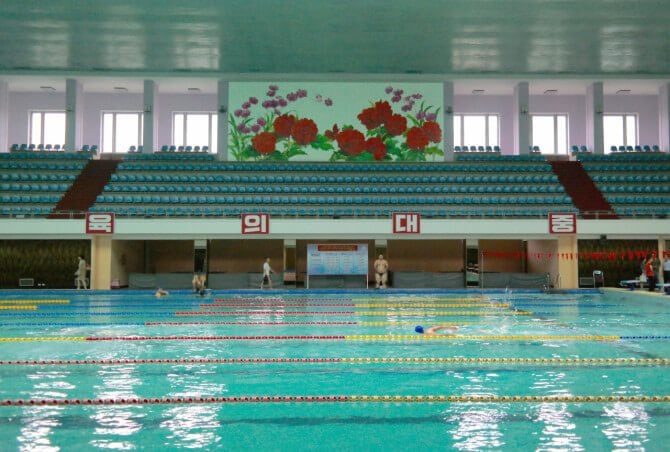
North Korean cities, especially Pyongyang, tend to present broad avenues, formal public squares, and large-scale apartment blocks. Monuments, murals, mosaics, and propaganda graphics appear throughout public space. In architecture, concrete dominates, but facades are often softened with colour, ornament, and symbolic motifs designed to project order and confidence.
That visual language extends into interiors and object design. Official rooms often feature polished wood, heavy drapery, lacquered surfaces, and carefully arranged furniture that signals discipline and prestige. In photography and film, those spaces are frequently empty or sparsely occupied, which gives them a theatrical quality: they are made to be seen as much as used.
Why does North Korea matter to design and visual culture?
North Korea matters because it is a rare case where design is inseparable from political messaging. Public art, architecture, typography, dress, and ceremony all help project the authority of the state and the image of a unified society. Even mundane things, such as street signs or apartment facades, can carry ideological weight.
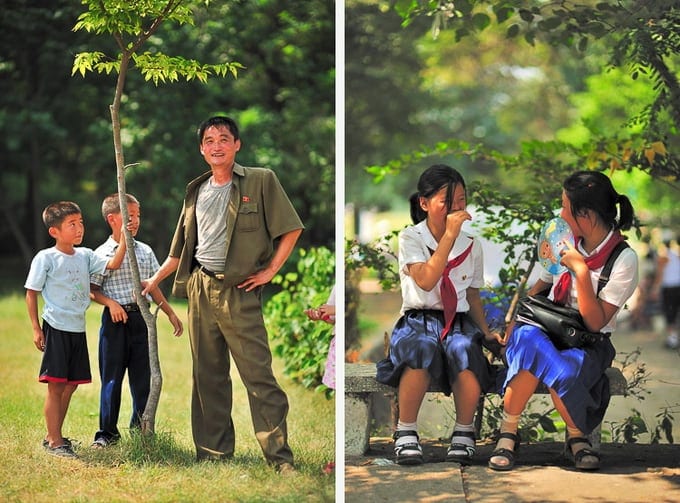
For editors, photographers, and researchers, the country is also a problem of access. Most visual material comes from controlled tours, state media, defectors’ accounts, or a small number of carefully managed reportage projects. That scarcity makes every image feel loaded, but it also means the visual record can flatten everyday life into spectacle. Careful reporting has to separate what is officially staged from what people actually make, use, and live with.
How is North Korean art and imagery made?
North Korean art is strongly shaped by socialist realism, but with local features tied to the cult of leadership and revolutionary history. Painters, sculptors, and poster designers work within a narrow approved range of subjects: industrial labour, military strength, agricultural abundance, family loyalty, and historical struggle. The finished works often use bright colour, crisp outlines, and idealised figures, all arranged for immediate legibility.
Craft traditions have not disappeared, but they are usually absorbed into official culture. Embroidery, calligraphy, ceramics, and applied arts may appear in state exhibitions or as diplomatic gifts, where they are valued for refinement and national character. In practice, the making process is less about individual expression than about discipline, repetition, and alignment with state themes.
What can be learned from seeing the country through images?
Photography and travel publishing have made North Korea familiar as a place of restricted streets, choreographed public life, and monumental architecture. Books and photo essays often focus on the tension between emptiness and display: a parade ground, a schoolroom, a hotel corridor, a supermarket with little stock. Those images are useful, but only when read with caution.
The strongest visual work on North Korea does more than repeat the stereotype of mystery. It pays attention to material detail: the finish on a bench, the texture of a curtain, the scale of a housing block, the graphics on a facade, the way uniforms and interiors are coordinated. Those details show how a state can build a visual world that is both highly controlled and deeply revealing.
Frequently Asked Questions
Is North Korea the same as the Korean Peninsula?
No. The Korean Peninsula includes both North Korea and South Korea, along with the territory between them. North Korea is only the northern state on that peninsula. The distinction matters because many historical, cultural, and design references use “Korean” more broadly than “North Korean.”
Why do so many articles about North Korea focus on architecture?
Architecture is one of the most visible ways the state communicates scale, power, and permanence. Wide boulevards, monumental facades, and symbolic public buildings are easier to photograph than private life, and they are also deliberately designed to be photographed. As a result, architecture often becomes the clearest evidence of how the country wants to be seen.
Can North Korean art be discussed apart from politics?
Only to a point. The state’s cultural system shapes subject matter, style, production, and circulation so thoroughly that politics is built into the work itself. Discussion can still address composition, technique, colour, and craft, but those features sit inside a political framework rather than outside it.
At a glance
- Address
- North Korea
- Coordinates
- 39.033333, 125.75
Articles mentioning North Korea