
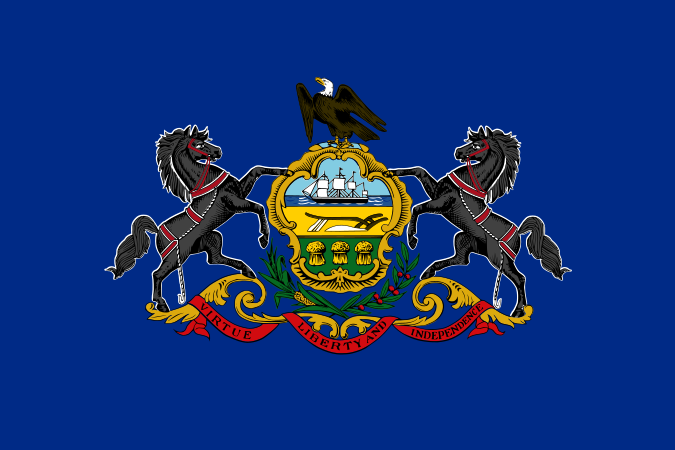
Pennsylvania is a state in the northeastern and mid-Atlantic United States, with a landscape shaped by the Appalachian Mountains, river valleys, industrial cities, farmland, and a long industrial past. It is one of the original thirteen colonies and one of the places where American manufacturing, printing, coal extraction, and design education took on an early and lasting shape.
| Type | US state |
|---|---|
| Capital | Harrisburg |
| Largest city | Philadelphia |
| Region | Northeast, Mid-Atlantic, parts of the Great Lakes watershed |
| Known for | Early American industry, coal and steel production, major museums, universities, and strong craft traditions |
| Geography | Appalachian ridges, Piedmont lowlands, the Delaware and Susquehanna river systems, Lake Erie shore |
Where Pennsylvania sits, and why that matters
Pennsylvania sits between the Atlantic seaboard and the interior of the United States. That position made it a corridor for trade, migration, and manufacturing, with Philadelphia connecting to the coast and Pittsburgh tied to inland river and rail networks. The state’s geography also varies sharply: eastern counties sit on older urban and agricultural ground, while the center and west rise into the Appalachian plateau and mining regions.
This mix matters because it shaped how the state made things. Coal, iron, glass, steel, textiles, paper, furniture, and printed matter all developed in different parts of Pennsylvania, often close to raw materials and transport routes. The state’s built environment still reflects that history in rowhouses, mills, warehouses, company towns, and converted industrial buildings.
What does Pennsylvania look like in practice?
Pennsylvania is not one visual style. Philadelphia carries dense brick streets, colonial-era landmarks, civic institutions, and a strong museum culture. Pittsburgh shows another side: bridges, steep hills, riverfront industry, and a city image long tied to steel production. Outside the cities, barns, covered bridges, stone farmhouses, and small-town main streets give the state a more rural and agrarian character.
For designers, artists, and makers, that variety is part of the appeal. Pennsylvania offers access to both historic craft and industrial reuse: old mills become studios, decommissioned factories become lofts, and regional materials such as wool, metal, wood, and paper continue to support making. Its institutions, especially in Philadelphia and Pittsburgh, also give the state an outsized role in art education, exhibition, and conservation.
How Pennsylvania became an industrial state
Pennsylvania’s industrial identity grew from geology and infrastructure. Coal deposits in the west and center fed ironworks, railroads, and eventually steel production. Rivers such as the Delaware, Schuylkill, Allegheny, Monongahela, and Ohio carried raw materials and finished goods. In the nineteenth and twentieth centuries, the state became one of the key engines of American manufacturing.
That history still shapes the visual culture associated with Pennsylvania. Factory interiors, machine parts, stamped metal, enamelware, printed ephemera, and utilitarian furniture often trace back to the state’s industrial system. Even when those objects are no longer made there, Pennsylvania remains strongly linked to the language of durability, mass production, and hard-wearing materials.
Why Pennsylvania matters to art, design, and material culture
Pennsylvania matters because it sits at a meeting point of craft, industry, and institutional culture. Philadelphia has long supported printing, furniture, textile work, and museum collecting. Pittsburgh became known for industrial design, architecture, and postwar innovation. Across the state, universities, makers, and artists have used that infrastructure to study materials, test processes, and preserve older techniques.
In practice, that shows up in many forms: woven textiles, shaped paper, repaired objects, laboratory-driven wearable technology, landscape representation, and work that uses maps, wool, metal, or found materials. Pennsylvania is less a single brand than a working ground where American making has repeatedly shifted from extraction and factory production to reuse, research, and contemporary craft.
Frequently Asked Questions
Is Pennsylvania considered part of the Northeast or the Mid-Atlantic?
Both. Pennsylvania is commonly grouped with the Northeast and Mid-Atlantic, and some classifications also include its northwestern edge in the Great Lakes region because of Lake Erie. The overlap reflects the state’s size and varied geography.
Why is Pennsylvania so often linked to industry?
The state had the resources and transport systems needed for industrial growth, especially coal, iron, rail lines, and navigable rivers. Those conditions supported steel, machinery, textiles, and printing at a large scale. The result was a dense material culture built around labor, production, and urban growth.
What are the most visually distinctive parts of Pennsylvania?
Philadelphia, Pittsburgh, the Appalachian ridges, and the rural farm country each present a different image of the state. Brick city grids, steel bridges, river valleys, and stone barns all stand out. That range makes Pennsylvania useful as a reference point for both urban and rural visual culture.
At a glance
- Address
- United States
- Coordinates
- 41.203322, -77.194525
Articles mentioning Pennsylvania


