
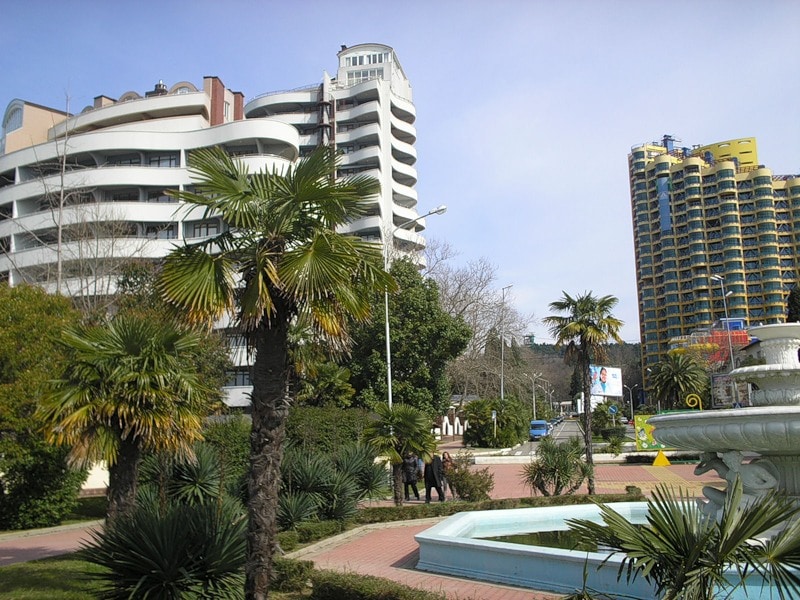
A skyscraper is a continuously habitable tall building with many storeys, built to carry people, work, and services upward rather than spread them across a large footprint. There is no single legal height that makes a building a skyscraper, but the term usually applies to towers that dominate a city skyline and rely on a structural frame, often steel or reinforced concrete, with a non-load-bearing curtain wall on the outside.
- Skyscrapers emerged in the late 19th century as cities grew denser and elevators made great height practical.
- Their defining feature is not only height but a building system that moves loads through a frame, not thick external walls.
- Modern skyscrapers often use steel, reinforced concrete, or hybrid timber systems, along with curtain walls of glass, metal, or stone veneer.
- They are most common in business districts, where land values justify building upward.
- Today the term covers a wide range of forms, from slim office towers to mixed-use residential and hotel buildings.
What makes a building a skyscraper?
The word describes more than a tall shape. A skyscraper is meant to be occupied throughout its height, with lifts, stairs, mechanical systems, fire protection, and structural engineering designed for daily use. That separates it from towers built mainly for observation, broadcasting, or symbolic display.
Because no official height threshold exists, classification depends on context. A 20-storey tower may count as a skyscraper in one city and not in another. The important traits are vertical density, a strong structural frame, and a form that changes the surrounding skyline.
How did skyscrapers develop?
Skyscrapers appeared in the late 1800s in North American cities such as Chicago and New York, where land pressure and new technologies pushed buildings upward. The elevator made upper floors practical, while structural steel and improved fireproofing removed many of the old limits of masonry construction. Before that, load-bearing walls had to grow thicker as buildings rose, which made extreme height impractical.
The early skyscraper established a pattern that still shapes high-rise design: a frame does the structural work, and the exterior skin hangs from it or wraps it. This allowed taller and lighter buildings with larger windows and more flexible floor plans. Over time, the skyscraper became a sign of corporate power, urban ambition, and engineering competence.
What do skyscrapers look like in practice?
In practice, most skyscrapers are assembled from a structural core and an outer frame. The core usually holds lifts, stairs, and services, while the perimeter frame carries wind and gravity loads. Steel has long been central because it is strong, relatively light, and quick to erect, though reinforced concrete and steel-concrete hybrids are equally common. Some recent towers also use mass timber for portions of their structure, especially in hybrid systems.
On the outside, many skyscrapers use curtain walls: thin façades that do not support the building’s weight. These can be all glass, or they may combine glass with aluminium, stone, ceramic, or other cladding. The result is often a building with a repetitive grid, visible floor plates, and a façade that reflects the business and climate of its place.
Why do skyscrapers matter?
Skyscrapers concentrate large numbers of people and functions on a small site, which makes them a practical response to expensive land and dense urban centres. They are especially useful for offices, hotels, apartments, and mixed-use developments where many services can share a single vertical stack. Their height also creates public debate, because they can reshape views, overshadow historic districts, and alter wind, shade, and traffic patterns at street level.
They matter culturally as much as economically. A skyline tower can become a city emblem, a symbol of growth, or a point of controversy when it appears to threaten heritage sites or local scale. Recent projects increasingly use low-carbon materials, engineered timber, and energy-efficient façades, showing that the skyscraper is still evolving rather than fixed as a 20th-century form.
Frequently Asked Questions
Is a skyscraper the same as a high-rise?
Not exactly. “High-rise” is a broader term for tall buildings, while “skyscraper” usually suggests greater height, stronger skyline presence, and a more iconic urban role. In practice, the boundary is fuzzy and varies by city and by who is using the term.
Do skyscrapers have to be made of steel?
No. Steel has been the classic skyscraper material because it makes tall framing efficient, but many towers use reinforced concrete, and some modern buildings combine steel, concrete, and timber. What matters is the structural system, not a single material.
Why do skyscrapers often have glass walls?
Glass curtain walls became popular because they are light, visually slim, and compatible with framed construction. They let in daylight and give towers a polished, modern appearance, though they also create challenges with heat gain, glare, and energy use. Many current façades therefore use coatings, shading devices, or mixed materials to improve performance.
Articles mentioning Skyscraper


