
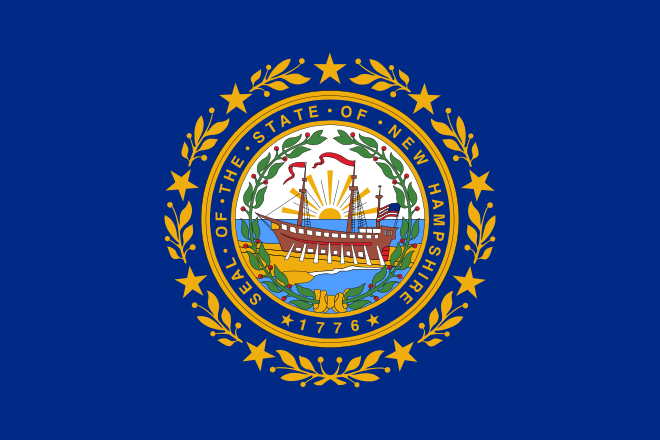
New Hampshire is a state in New England, in the northeastern United States, known for its rocky coast, White Mountains, lake country, and a political culture that values local control. It was named for the English county of Hampshire and sits between Massachusetts, Vermont, Maine, Quebec, and the Atlantic Ocean. Though small in population and land area, it carries outsized cultural weight through its early presidential primary, its tourism economy, and a long history of craft, print, and landscape imagery.
| Type | U.S. state |
|---|---|
| Region | New England, northeastern United States |
| Capital | Concord |
| Largest city | Manchester |
| Entered the Union | 1788 |
| Known for | White Mountains, lakes, fall foliage, winter tourism, political first-in-the-nation primary |
What kind of place is New Hampshire?
New Hampshire is a compact state with a strong regional identity. Its terrain shifts quickly from coastal marshes and river valleys to forested hills, the granite bulk of the White Mountains, and the lakes and mill towns of the interior. That geography shaped settlement patterns, logging, paper making, and later recreation and tourism. The state is less urban than many parts of the Northeast, and much of its built environment still reflects small-town patterns, local industry, and seasonal use.
The state’s size and population are often misleading. New Hampshire ranks among the smallest U.S. states by area, yet its place in American civic life is unusually visible because of the presidential primary, live-free-or-die state branding, and a long-standing emphasis on state sovereignty. That mixture of rural landscape and high political profile makes it a recurring setting for documentary photography, landscape work, and regional portraiture.
How did New Hampshire get its character?
English colonists settled the area in the 17th century, and the colony eventually took its name from Hampshire in England. Before that, the region was home to Indigenous peoples including the Abenaki, whose presence and displacement are part of the state’s deeper history. The colonial economy grew around fishing, timber, shipbuilding, agriculture, and small manufacturing, especially where rivers could power mills.
In the 19th century, textile mills, paper mills, and granite quarrying expanded the industrial base. Towns such as Manchester, Nashua, and Berlin developed around water power and factory labor, while the mountains and lakes began to attract summer visitors. That split between industrial towns and scenic hinterlands still shapes how the state looks and how it is photographed: mills, bridges, clapboard houses, snow-covered roads, and wide seasonal skies all sit within a short drive of one another.
Why does New Hampshire matter culturally?
New Hampshire matters because it compresses several American narratives into one place: colonial settlement, the decline of New England industry, preservation of small-town life, and the rise of leisure landscapes. The state became a destination for writers, painters, hikers, skiers, and later road-trippers, all drawn by the mountains, lakes, and changing light. Autumn foliage in particular has become a visual shorthand for the state, but winter, mud season, and late-summer haze are equally characteristic.
Its visual culture tends to favor directness. Rural churches, town halls, roadside diners, logging trucks, second homes, and weathered barns all appear in the same frame as polished tourist architecture and university campuses. For photographers, that variety offers a controlled but expressive environment: strong seasons, dense weather, and a built landscape that still carries traces of older labor.
Why do photographers and image-makers use New Hampshire so often?
New Hampshire’s landscapes suit portrait and documentary work because they read clearly on camera without becoming generic. Snow gives clean tonal contrast; leaf season provides saturated color; granite ledges, lake surfaces, and weathered wood add texture. In winter, interiors matter more, and that turns attention toward domestic spaces, studio setups, and the details of clothing, light sources, and hand-built interiors. In warmer months, the state’s open roads and wooded edges support environmental portraits and location shoots with a strong sense of place.
The state also gives photographers a recognizable regional setting without the visual overload of a major city. That is useful for work that wants intimacy, solitude, or quiet labor. In portrait photography, New Hampshire often stands in for self-reliance, family history, and a life shaped by weather and distance. In that sense, the place is not just a backdrop; it is part of the image’s meaning.
Frequently Asked Questions
Is New Hampshire mostly rural?
Much of the state is rural or small-town in character, but it is not empty or purely pastoral. Manchester, Nashua, and the seacoast corridor hold a substantial share of the population and economic activity. The state works as a patchwork of mill cities, commuter towns, farm country, and mountain tourism zones.
What are the main visual landmarks of New Hampshire?
The White Mountains are the most famous natural landmark, especially Mount Washington and the surrounding peaks. The Lakes Region, the Merrimack River valley, and the short Atlantic coastline are also important. In built terms, covered bridges, old mills, colonial-era houses, and town greens appear often in photographs and travel imagery.
Why is New Hampshire important in American politics?
New Hampshire holds the first primary in the U.S. presidential nomination calendar, which gives it unusual influence despite its small size. Candidates spend time in diners, town halls, and local events because early performance there can shape the race. That political role is one reason the state appears so often in national media and documentary photography.