Burma, officially called Myanmar, is a country in Southeast Asia shaped by mountains, river plains, tropical coasts, and a long history of Buddhist art, royal building, colonial rule, and military government. It sits between India and Bangladesh on one side and Thailand, Laos, and China on the other, with a wide coastline on the Bay of Bengal and the Andaman Sea. For readers of visual culture, Burma matters for its temple cities, monastic life, woven textiles, lacquerware, wood carving, and architecture made from timber, brick, and gilded ornament.
- Burma and Myanmar refer to the same country; “Burma” remains common in older writing and some cultural contexts.
- The landscape ranges from the Irrawaddy River basin to coastal deltas, forested hills, and dry central plains.
- Its built culture is strongly shaped by Theravada Buddhism, visible in pagodas, monasteries, and religious sculpture.
- Traditional making includes weaving, basketry, lacquer, carving, and construction in timber and brick.
- Contemporary visual culture often balances those craft traditions with political change, conflict, and urban modernization.
Where is Burma, and why does its geography matter?
Burma occupies a strategic stretch of mainland Southeast Asia. The country links South Asia, China, and the mainland Southeast Asian states, and that position has shaped trade routes, migration, conflict, and the spread of religious and artistic forms. The Irrawaddy River and its delta support much of the country’s settlement and agriculture, while the eastern and western frontiers hold highland communities with distinct languages, dress, and making traditions.
Its geography also explains its visual variety. Central dry zones produce different building materials and settlement patterns from the wet coastal south or the forested hills near the borders. In towns and cities, especially around Yangon and Mandalay, colonial-era masonry, teak structures, modern concrete blocks, and temple compounds often stand close together. That layering gives Burma a particularly dense architectural record.
What does Burmese architecture look like?
Burma’s best-known buildings are Buddhist religious structures: gilded stupas, brick temples, ordination halls, monasteries, and shrine platforms. The surfaces often combine plaster, paint, gold leaf, carved wood, and mosaic glass. Older sites such as Bagan make the country famous for temple architecture, where thousands of brick monuments rise from a plain and create a landscape of repeated forms rather than one singular landmark.
Outside sacred sites, Burmese construction has long used teak and other hardwoods, especially for monasteries, houses, and public buildings. Carved brackets, pierced panels, and decorative eaves turn structural timber into ornament. In many urban settings, that tradition now sits beside concrete frame construction, but the older emphasis on shade, ventilation, and raised floors still appears in domestic and civic architecture.
How has Buddhism shaped Burmese visual culture?
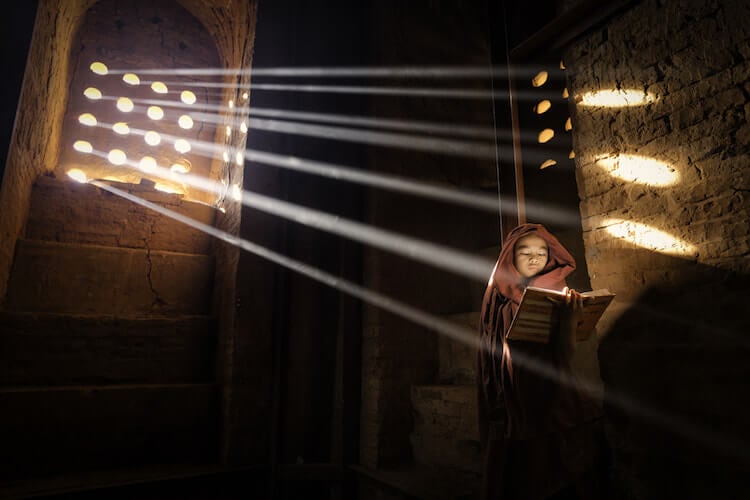
Theravada Buddhism has been central to Burma for centuries, and the religion shapes the country’s most recognizable images. Monks in maroon robes, novice students in monastic schools, and pilgrims circling pagodas appear again and again in photography and reportage. Religious life also produces a strong material culture: offering bowls, lacquered alms containers, painted umbrellas, votive plaques, and gilt decoration for stupas and Buddha images.
The monastic world matters beyond ritual. Monasteries have functioned as schools, libraries, and centers of artistic patronage, which is one reason Burmese manuscript painting, wood carving, and mural work developed such depth. Even in contemporary documentary photography, the visual rhythm of shaved heads, folded cloth, and temple compounds remains one of the clearest signs of the country’s identity.
What materials and crafts are associated with Burma?
Burma has a long craft tradition built around local materials. Lacquerware, especially from the Bagan area and nearby craft centers, uses layers of resin applied to bamboo or woven bases, then polished and sometimes incised with fine patterns. Weaving remains important across many regions, including cotton and silk textiles with strong color contrasts and geometric or floral borders. Basketry, silverwork, clay vessels, and wood carving also play major roles in daily and ceremonial life.
These crafts are not just souvenirs; they are part of how homes, monasteries, markets, and rituals are equipped. Materials often come from nearby landscapes: bamboo for baskets and scaffolding, timber for house frames and monastery furniture, lacquer from tree resin, and gold leaf for religious surfaces. In design terms, Burma shows how craft can organize ordinary life as much as it decorates it.
Why does Burma appear so often in photography?
Photographers are drawn to Burma because the country offers strong formal contrasts: bright temple gilding against monsoon skies, long rows of monks in deep color, teak columns against pale plaster, and wide river landscapes that hold morning mist. The built environment often frames people in repeated arches, stairways, and courtyards, which makes for clear, graphic compositions. Temples at sunrise and novice monks walking through compounds are among the country’s most persistent visual subjects.
That visual appeal can obscure the country’s complexity if it is treated only as an image source. Modern Burma includes political repression, ethnic conflict, migration, and rapid change, all of which affect how places are built and maintained. Good photography from the country usually shows both the formal beauty of its surfaces and the human conditions that shape them.
Frequently Asked Questions
Is Burma the same as Myanmar?
Yes. Burma and Myanmar refer to the same country, and both names appear in print depending on time period, political stance, and editorial style. “Burma” is older and still common in many cultural and historical contexts, while “Myanmar” is the official name used by the state.
What is Burma best known for visually?
Burma is best known for Buddhist temples, pagodas, monastic life, and craft traditions such as lacquerware and weaving. The country’s temple landscapes, especially at Bagan, are among the most distinctive built environments in Asia. Photography often focuses on monks, gilded shrines, and the warm surfaces of timber and brick architecture.
What materials are most associated with Burmese making?
Teak, bamboo, brick, plaster, lacquer, gold leaf, cotton, and silk are all closely associated with Burmese craft and building. These materials appear in monasteries, houses, ritual objects, textiles, and decorative surfaces. Their use reflects both local resources and a long tradition of handwork refined through religious and domestic life.
At a glance
- Address
- Myanmar
- Coordinates
- 19.75, 96
Articles mentioning Burma