Hasbro is an American toy and game company best known for turning playthings into global brands, from board games and action figures to dolls, craft compounds and licensed characters. Founded as Hassenfeld Brothers in Rhode Island, it grew from a family-run textile and school-supply business into one of the largest toy makers in the world.
| Founded | 1923, as Hassenfeld Brothers |
|---|---|
| Headquarters | Pawtucket, Rhode Island, United States |
| Former name | Hassenfeld Brothers |
| Core business | Toys, board games, dolls, licensed entertainment brands |
| Manufacturing | Mostly outsourced to factories in East Asia |
How did Hasbro become so influential?
Hasbro’s scale comes from brand ownership. Rather than selling only standalone toys, the company builds product lines that can move across packaging, cartoons, films, games and retail displays. Monopoly, Play-Doh, My Little Pony and Transformers are the best-known examples, each supported by design teams, product engineering, marketing and licensing agreements that keep the brand active across generations.
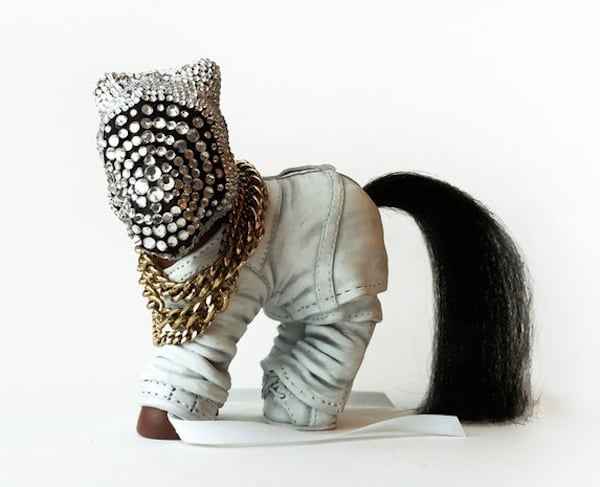
That approach made Hasbro important to visual culture as well as play. Its products often arrive with a fixed palette, logo system, moulded form or character design that other makers can reuse, alter or parody. In practice, Hasbro supplies the basic shapes and references that artists, customisers and collectors work from.
What does Hasbro make?
Hasbro’s output ranges from board games with printed cards and cardboard components to injection-moulded plastic figures, dolls with rooted hair, soft goods, craft materials and miniature accessories. Play-Doh, one of its most recognisable products, is a modelling compound sold in tubs and colour sets for shaping by hand or with tools and moulds. My Little Pony began as a toy line built around plastic horse figures and stylised manes, later expanding into animation, fashion, fan art and custom toy culture.
The company’s products are designed for mass manufacture, so they tend to rely on repeatable processes: moulding, printing, assembly, packaging and high-volume colour matching. Much of that production happens in East Asian factories, where the tooling and labour needed for plastic toys and board-game components are concentrated. Hasbro controls the design and brand identity, while manufacturing is typically distributed through contracted suppliers.
Why does Hasbro matter in design and popular culture?
Hasbro matters because it shows how industrial design, marketing and character creation can fuse into one system. A successful Hasbro product is not only an object but a platform: it can be recoloured, reissued, customised or translated into another medium without losing recognisability. That flexibility helps explain why collectors, artists and independent makers continue to work from Hasbro properties.
FreeYork’s articles on Play-Doh Blooms and Mari Kasurinen’s My Little Pony transformations show this clearly. Play-Doh becomes a medium for sculpted floral arrangements, while a mass-market pony doll becomes the base for detailed pop-culture reinterpretation. Hasbro’s value lies partly in that openness to reuse; the company’s forms are rigid enough to be standardised and simple enough to be remade.
Where is Hasbro based, and how is it organised?
Hasbro is headquartered in Pawtucket, Rhode Island, in the United States. Its history is tied to the Hassenfeld family, who founded the business in the early twentieth century and later expanded it into a multinational corporation. The company’s American base handles strategy, brand management and licensing, while production is mostly handled overseas.
That split between design ownership and physical manufacture is typical of the modern toy industry, but Hasbro exemplifies it at a large scale. The company’s name is attached less to a single craft tradition than to a network of industrial processes, from prototyping and tooling to packaging and global distribution.
Frequently Asked Questions
Is Hasbro just a toy company?
No. Hasbro is primarily a toy and game company, but its business depends heavily on entertainment branding, licensing and character management. Many of its best-known products exist as media franchises as much as toys.
What is the connection between Hasbro and Play-Doh?
Hasbro owns and markets Play-Doh as a mass-produced modelling compound. The material is made for hand shaping, pressing, cutting and moulding, which makes it useful both for children’s play and for crafted sculptural work. That versatility is why it can appear in art and design contexts far beyond the toy aisle.
Why do custom artists use Hasbro figures so often?
Hasbro figures have stable proportions, durable plastics and widely recognised character designs. Those qualities make them practical for repainting, sculpting over, recombining and turning into one-off artworks. The base object already carries cultural meaning, so alteration becomes visually legible at once.
At a glance
- Founded
- 1923
- Address
- Pawtucket, United States
Articles mentioning Hasbro