
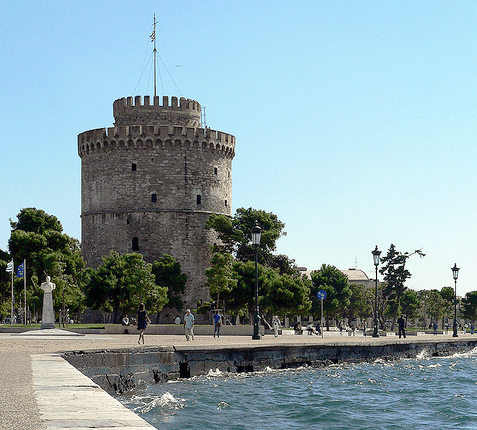
Thessaloniki is Greece’s second-largest city and the chief port and cultural centre of northern Greece. Also called Salonica or Thessalonica, it sits on the Thermaic Gulf and has long served as a crossroads between the Balkans, the Aegean, and the eastern Mediterranean.
- Founded in 315 BCE, it took its name from Thessalonike, the sister of Alexander the Great.
- It became a major city of the Roman Empire and later the Byzantine Empire, which left a dense urban fabric of churches, baths, walls, and markets.
- The city is known for layered architecture: Roman, Byzantine, Ottoman, and modern buildings occupy the same streets.
- Its waterfront, markets, and university districts make it a live center of design, publishing, food, and craft in northern Greece.
Why Thessaloniki matters
Thessaloniki matters because it has been a working city for more than two millennia. It was built as a planned Hellenistic port, then expanded under Roman rule into a commercial hub on the Via Egnatia, the road that linked the Adriatic to Byzantium. That position made it prosperous, strategically important, and heavily contested. The city’s history is visible in its streets: ancient walls climb the hills, Byzantine churches sit near Ottoman-era masonry, and postwar apartment blocks fill the gaps left by fire and redevelopment.
That layered urban form gives Thessaloniki a distinct character. It is not a museum city arranged around one period; it is a place where different construction methods and civic ambitions remain legible at once. The city’s survival of empire, conquest, fire, and modernization makes it especially useful for understanding how architecture accumulates rather than replaces itself.
What does Thessaloniki look like?
Thessaloniki is compressed between sea and hillside, which gives it a tight, vertical profile. The waterfront is broad and open, while the upper city rises into denser neighborhoods with narrow streets, stepped routes, and surviving fortifications. The White Tower, the city’s best-known landmark, stands on the promenade as a stripped, cylindrical stone structure once tied to Ottoman defensive works. Nearby, the city’s Byzantine churches use brick, stone, mosaics, and domes to create compact interiors that feel distinct from the larger scale of later civic buildings.
The city’s visual language mixes repair and reuse. Ottoman houses, neoclassical facades, modern concrete blocks, and reconstructed archaeological sites all occupy the same field. In markets and workshop districts, the scale becomes smaller and more tactile: metal shutters, tiled interiors, hand-painted signs, and food stalls continue the older logic of street commerce. Thessaloniki’s appeal to designers and photographers comes from this density of texture and from the way the city keeps showing its historical layers rather than smoothing them away.
How did the city become so important?
Thessaloniki grew by combining port access with administrative and religious importance. Under Rome, it served as a regional capital and trading point. Under Byzantium, it became the empire’s second city after Constantinople, a role reflected in its honorific status as a “co-reigning” city. That prestige helped attract churches, monasteries, artisans, and scholars, and it left behind some of the finest surviving Byzantine architecture in Greece.
Later rule under the Ottoman Empire added another layer of civic form, from mosques and hammams to domestic housing types and urban street patterns. The 20th century brought population exchange, fire, redevelopment, and rapid growth, which changed the city but did not erase its older structure. Thessaloniki remains important because it links these different eras in one place and makes the city itself a readable record of eastern Mediterranean history.
What should be noticed in practice?
In practice, Thessaloniki is best understood through its materials and street life. Stone walls and brick arches show Byzantine construction; marble fragments and columns survive in archaeological zones; concrete apartment buildings from the postwar period mark the city’s modern expansion. Churches such as Hagia Sophia and Agios Dimitrios reveal how brick vaulting, mosaics, frescoes, and domes were used to shape sacred space, while the markets and waterfront show how commerce still organizes daily life.
For FreeYork readers, Thessaloniki matters as a place where architecture, preservation, and urban routine intersect. It demonstrates how a city can hold on to multiple design histories without becoming static. Its value is not only in individual monuments but in the way those monuments sit inside an active, lived-in city.
Frequently Asked Questions
Is Thessaloniki a Greek or Byzantine city?
It is a Greek city today, but its historical significance was formed across several empires. The city became one of the most important urban centres of the Byzantine Empire, which is why so much of its surviving architecture is Byzantine in character. Modern Thessaloniki belongs to Greece, yet its urban fabric still carries Roman, Byzantine, Ottoman, and modern Greek layers.
Why is Thessaloniki sometimes called Salonica?
Salonica is an older Western European name for the city, used widely in English and other languages for centuries. Thessalonica is another historical form, closer to the ancient and Byzantine names. All of these refer to the same city, though Thessaloniki is the modern Greek name now used officially.
What is Thessaloniki known for in visual culture?
Thessaloniki is known for its Byzantine churches, waterfront promenade, layered streetscape, and dense architectural mix. Its visual identity comes from surviving stone, brick, mosaics, and Ottoman-era remnants set beside modern apartment blocks and commercial streets. That combination makes it a strong reference point for anyone studying historic urban texture and the way cities accumulate design over time.
At a glance
- Address
- Thessaloniki Municipality, Greece
- Coordinates
- 40.65, 22.9
Articles mentioning Thessaloniki

