
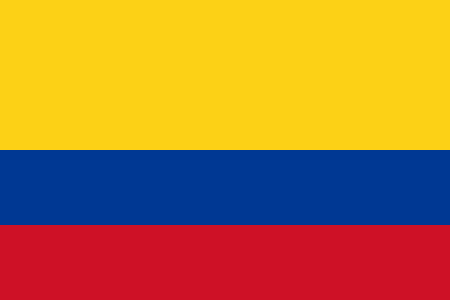
Colombia is a country in northwestern South America, bordered by Panama, the Caribbean Sea, Venezuela, Brazil, Peru, Ecuador, and the Pacific Ocean. It is a unitary constitutional republic made up of 32 departments, with a landscape that ranges from Caribbean coastlines and Andean highlands to Amazon rainforest, Orinoquía plains, and Pacific mangroves. That variety shapes how Colombians build, farm, travel, make objects, and work with materials.
- Colombia sits at a geographic crossroads between Central America, the Caribbean, the Andes, the Amazon, and the Pacific.
- Its territory includes major climatic and ecological zones, from tropical lowlands to cool mountain cities.
- Architecture, craft, and design often draw on local materials such as bamboo, clay, wood, fique, and woven fibers.
- Colombia’s cultural production is regional rather than uniform; coast, mountains, and interior cities each carry distinct traditions.
- The country’s scale and biodiversity make it important in art, ecology, and design conversations across Latin America.
Where is Colombia, and what makes it distinct?
Colombia occupies the northwestern corner of South America, where land routes, river systems, and coastlines connect several regions at once. Unlike countries defined by a single landscape, Colombia includes Caribbean shores, the two Andean cordilleras, the Amazon basin, and a long Pacific edge. That combination gives the country an unusual density of climates, from humid tropical heat to high-altitude cold.
Its position also matters culturally. Colombia has long been shaped by indigenous societies, Spanish colonial rule, African diasporic communities brought through the Atlantic world, and later internal migration between regions. The result is a country where material culture rarely looks generic: buildings, textiles, ceramics, foodways, and street life often reflect the local environment and the histories of the people making them.
How do landscape and climate shape Colombian design?
Material choices in Colombia often respond to climate first. In the Caribbean and Pacific lowlands, builders have relied on breathable forms, raised structures, timber, and woven or light-cladding systems that handle heat and rain. In the highlands, heavier masonry, brick, tile, and adobe have been common, especially where cooler temperatures and urban density favor more solid construction.
Bamboo, especially guadua, is one of Colombia’s best-known structural materials. It appears in rural architecture, contemporary houses, and community projects because it is strong, flexible, fast-growing, and locally available. Clay tile, fired brick, ceramic objects, and handwoven plant fibers also play a visible role in everyday Colombian making, from roofs and façades to furniture and domestic containers.
Why does Colombia matter in art and architecture?
Colombia matters because it produces work that is rooted in place without being visually closed off. Architects and artists there often combine modern forms with local materials and craft knowledge rather than treating tradition as decoration. That can mean a cultural center built with brick and shade-making devices suited to the tropics, or a contemporary artwork that uses earth, spice, fiber, or vegetal matter as a physical medium.
In the arts, Colombia has an especially strong relationship to landscape and bodily material. Artists such as Delcy Morelos have used earth, spice, and scent to build immersive installations, turning raw substances into spaces rather than objects. In design and craft, Colombian makers often emphasize handwork, texture, and regional references, whether the result is a ceramic vessel, a desk accessory shaped by roof tiles, or a public building that borrows from domestic construction methods.
What does Colombian material culture look like in practice?
Colombian material culture is not one style but many linked practices. In the Caribbean city of Barranquilla, for example, architecture can be extroverted, colorful, and community-facing, shaped by heat, social life, and local identity. In the Andes, designers may lean on brick, terracotta, and more enclosed spatial planning. In craft, makers often use ceramic clay, palm fibers, wood, natural pigments, and textile techniques that carry regional knowledge.
That diversity also appears in small objects. A handcrafted desk organizer inspired by roof tiles, or porcelain containers shaped by local ceramic traditions, may seem modest, but these objects carry a clear Colombian visual language: practical, tactile, and tied to the materials of domestic life. The same pattern shows up at larger scales in housing, cultural centers, and landscape-based installations.
Frequently Asked Questions
Is Colombia part of the Andes?
Yes. Three branches of the Andes run through Colombia, making the country one of the most important Andean territories. Large cities such as Bogotá, Medellín, and Cali sit in or near mountainous zones shaped by that geography. The Andes strongly influence climate, settlement patterns, and building materials.
What materials are associated with Colombian craft and architecture?
Several materials recur: guadua bamboo, clay brick, terracotta tile, wood, ceramic clay, and woven plant fibers. In some regions, earth, stone, and palm-based materials are also central. These choices are practical, but they also carry regional identity and a strong sense of texture.
Why is Colombia often mentioned in design and art coverage?
Colombia has a vibrant field of architecture, craft, and contemporary art that draws on local materials and social concerns. Its regional diversity gives makers a broad palette, from tropical construction systems to highland ceramics and urban cultural buildings. That makes the country a frequent reference point for work that links form, climate, and cultural memory.