
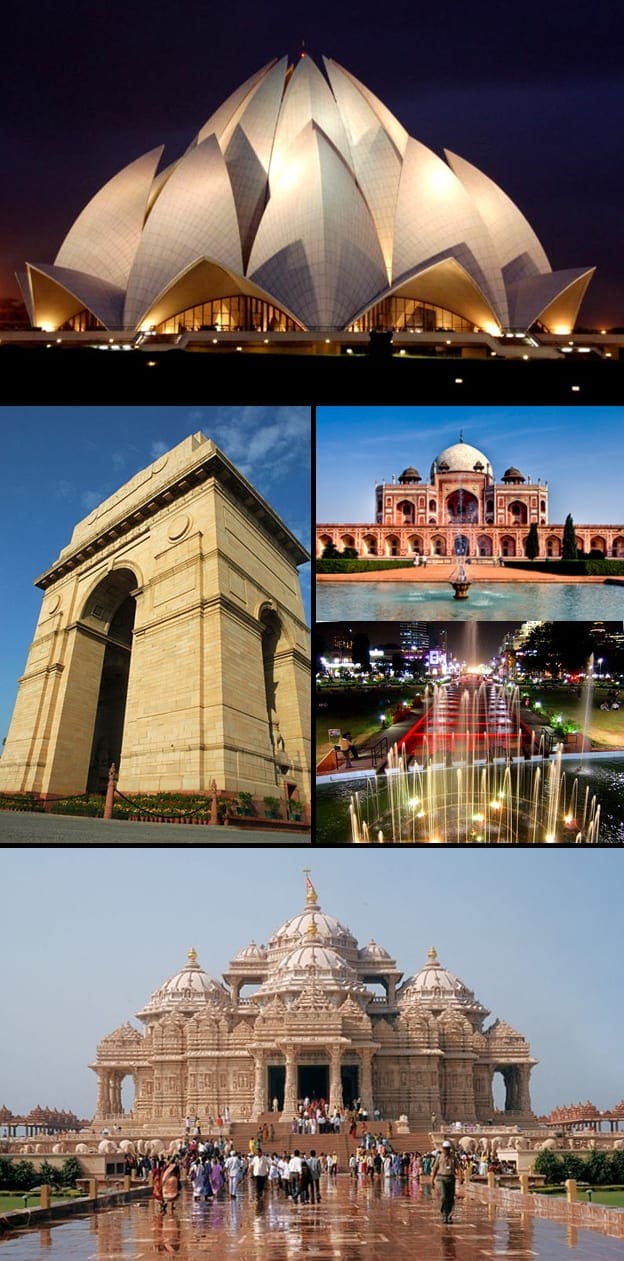
Delhi is India’s National Capital Territory, a large metropolitan region on the Yamuna River that contains New Delhi, the seat of the national government. It is one of the country’s biggest urban centres and a place where imperial planning, old city bazaars, roadside commerce, and dense residential neighbourhoods sit side by side. For visual culture, Delhi matters because its streets, walls, markets, transport corridors, and climate all shape how images are made and seen.
- Delhi combines the historic city of Old Delhi with the planned capital of New Delhi and many newer satellite districts.
- Its visual character is built from layered architecture, street signage, painted walls, construction scaffolding, and heavy traffic.
- The city is a major site for contemporary art, photography, public mural work, and street-based image making.
- Extreme heat, dust, monsoon rain, and pollution affect materials, surfaces, and everyday urban life.
- Delhi’s scale and density make it a place of constant visual change rather than a fixed city image.
What is Delhi?
Delhi is both a city and a territory. The National Capital Territory of Delhi includes New Delhi, where the central government is based, as well as Old Delhi and many surrounding urban districts. This makes Delhi less a single city in the neat sense than a connected metropolitan region with many layers of history, administration, and street life.
Its geography sits on the Yamuna and in the north Indian plains, which has shaped settlement, trade, and movement for centuries. Successive rulers built capitals here, from Mughal Delhi to the British-planned imperial centre of New Delhi. That long sequence of building, demolition, and rebuilding remains visible in the city’s architecture and in the way different districts feel almost like separate cities.
Why does Delhi matter in visual culture?
Delhi matters because it is intensely legible as a made environment. Formal government buildings, inherited monuments, informal markets, advertising, religious architecture, painted shopfronts, and improvised street structures all coexist. For photographers, artists, and designers, that mix offers a dense field of surfaces and signs: peeling walls, hand-painted typography, tile, concrete, dust, fabric, and metal.
The city also appears often in work that deals with speed, congestion, and social contrast. A street photograph from Delhi can include wildlife moving through the city, intense colour on market walls, or the effects of heat on roads and daily routines. Contemporary artists such as Bharti Kher have drawn on the city’s materials and contradictions, while public-facing mural projects use its walls as large-scale supports for image-making.
What does Delhi look like on the ground?
Delhi’s visual identity changes sharply from one district to another. In Old Delhi, narrow lanes, crowded bazaars, overhead wires, and layers of signage create a compressed visual field. In New Delhi, broad avenues, formal institutions, gardens, and planned vistas produce a more open and ceremonial order. Beyond these cores, newer areas often show construction, glass towers, flyovers, and traffic infrastructure that expand the city outward.
Colour is part of Delhi’s everyday look, but not in a purely decorative way. Painted shutters, fabric stalls, devotional objects, commercial signage, vehicle decals, and wall art all compete for attention. The city’s surfaces are also shaped by wear: soot, dust, sun-fading, monsoon staining, and heat damage alter how colour reads over time.
How do heat and weather affect the city?
Delhi’s climate has a direct effect on both daily life and the look of the city. Severe summer heat can make roads buckle and materials soften or crack, while dust and air pollution dull distant views and leave a film on buildings, vehicles, and printed matter. In visual work, these conditions matter because they change how surfaces age and how images survive outdoors.
The monsoon brings another kind of transformation. Rain darkens asphalt, loosens poster paste, stains walls, and exposes drainage problems. In a city as large and crowded as Delhi, weather is not just background. It becomes part of the visual record, visible in damaged roads, temporary coverings, and the constant maintenance required to keep the city functioning.
Frequently Asked Questions
Is Delhi the same thing as New Delhi?
No. New Delhi is the planned capital district where major government buildings are located, while Delhi is the wider metropolitan territory that includes New Delhi, Old Delhi, and many other districts. In everyday speech, the two terms are often blended, but they are not identical. New Delhi is part of Delhi, not a separate city in the larger sense.
Why do artists and photographers work in Delhi so often?
Delhi offers strong contrasts in a small visual span: monuments, markets, official architecture, informal settlements, traffic, and public art all sit close together. That density gives artists many kinds of material to work with, from colour and typography to weathered concrete and street activity. The city also provides a clear setting for work about urban change, heat, and social pressure.
What makes Delhi visually distinctive?
Its layered urban form. Few cities place Mughal-era structures, colonial planning, roadside commerce, and contemporary infrastructure into such direct contact. The result is a city where old stone, fresh paint, dust, billboards, and unfinished construction all share the same frame.
At a glance
- Address
- National Capital Territory of Delhi, India
- Coordinates
- 28.61, 77.23
Articles mentioning Delhi


