Frank Sinatra was an American singer and film actor whose voice, phrasing, and image made him one of the most influential entertainers of the 20th century. He began in the swing era with Harry James and Tommy Dorsey, then became a solo star in the 1940s through Columbia Records, where his recordings turned him into a mass-market idol and a new kind of pop vocalist.
- Born Francis Albert Sinatra in Hoboken, New Jersey, in 1915; died in 1998.
- Broke through as a big-band singer before becoming a solo recording star.
- Known for close-miked vocal style, precise timing, and strong interpretive control.
- Also built a major film career and became a durable style figure in American popular culture.
- Associated with the rise of the modern album as a serious format for popular song.
How did Sinatra become a star?
Sinatra’s career started in the dance-band world, where singers had to project personality inside a large orchestra. With Harry James and then Tommy Dorsey, he learned how to work with arrangement, tempo, and microphone technique. That training mattered: Sinatra did not sing like an operatic crooner. He worked the lyric closely, leaned into syncopation, and made small changes in emphasis feel dramatic.
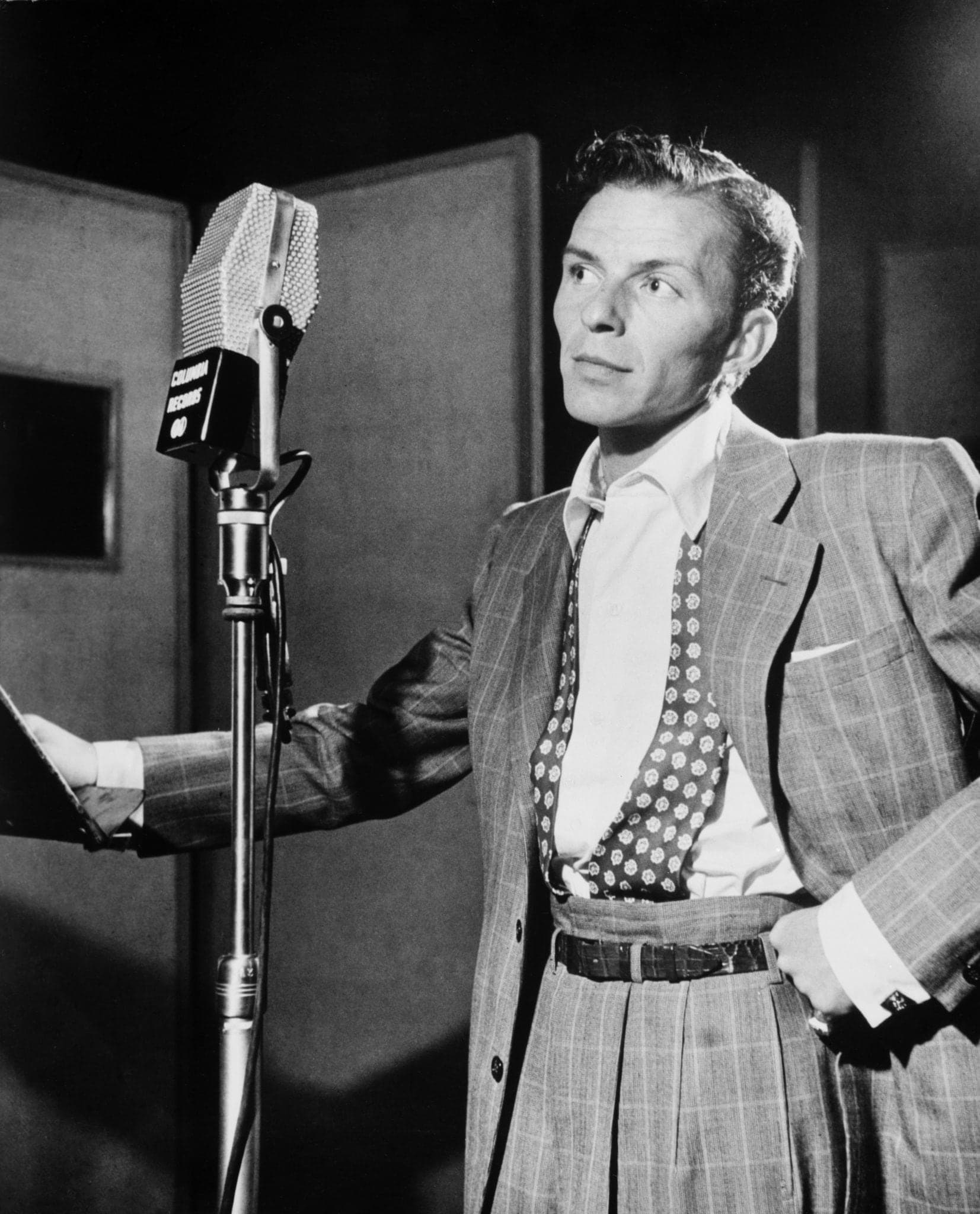
His solo breakthrough in the early 1940s came at a moment when radio, records, and fan magazines could turn a singer into a national figure almost overnight. Columbia Records gave him a platform for hits and for the kind of emotional, intimate delivery that set him apart. Young fans, especially the “bobby soxers,” responded to both the sound and the carefully managed image: tailored suits, slick hair, and an easy confidence that projected glamour without stiffness.
What made his singing distinct?
Sinatra’s voice was not the largest in American popular music, but he used it with unusual intelligence. He controlled breath so the line could move naturally, treated lyrics as speech shaped into melody, and made the microphone part of the instrument. That approach helped define the modern pop singer, one who could sound conversational, intimate, and emotionally exact without shouting.
He also had a sharp sense of repertoire. Sinatra recorded show tunes, standards, and new popular songs, but he rarely sang them as neutral material. He altered a phrase, stretched a note, or delayed an entrance to create tension. Later arrangers and producers built recordings around that skill, especially in the 1950s, when his concept albums gave popular song a more coherent, album-length structure.
Why does Sinatra matter in visual culture?
Sinatra mattered visually because his persona was so legible. He was photographed constantly, and the image took shape across records, posters, magazine covers, film stills, and studio publicity. The narrow tie, fedora, tuxedo, and controlled expression became shorthand for urbane male style. He helped standardize a look of cool professionalism that designers, advertisers, and photographers could reuse for decades.
He also linked music stardom to a broader media system. By moving between recording, film, and public appearance, he showed how a performer could become a brand without losing the sense of live performance. That mix of polish and immediacy still influences portraiture and celebrity imagery: the best Sinatra images do not just show a famous man, they stage attitude, authority, and a carefully managed distance.
Film roles, image-making, and legacy
Sinatra’s film career reinforced the same qualities. He appeared in musicals, dramas, and crime films, sometimes as a charming lead and sometimes against type. His screen work extended his public identity, giving filmmakers another way to use his voice, face, and manner. Even when the acting was uneven, the casting mattered because it carried the authority of a known public style.
His legacy endures not only through standards such as “My Way” and “Fly Me to the Moon,” but through the model he created for popular performance. Singers after him inherited his phrasing, his relationship to arrangement, and his sense that style can be as important as volume. For photographers, illustrators, and designers, Sinatra remains a fixed reference point: a face, a suit, and a voice that still define mid-century American glamour.
Frequently Asked Questions
Was Sinatra mainly a singer or a film star?
Sinatra was both, but singing came first and remained central. His recording career built the fame that made film casting possible, and his movie roles then widened his audience. The two careers fed each other, with each new medium strengthening the same public persona.
What kind of music did Sinatra sing?
He sang swing-era popular music, standards, show tunes, and later carefully arranged album material. His best-known recordings often come from the Great American Songbook tradition, where lyric interpretation matters as much as melody. He did not specialize in one narrow genre so much as in a highly recognizable vocal approach.
Why is Sinatra still referenced in fashion and design?
His image condensed a whole style system into a few repeatable signs: suit, hat, tuxedo, and controlled body language. Those cues communicate confidence, sophistication, and old-school glamour with very little visual clutter. Designers still borrow that shorthand because it reads instantly, even decades later.
Articles mentioning Frank Sinatra