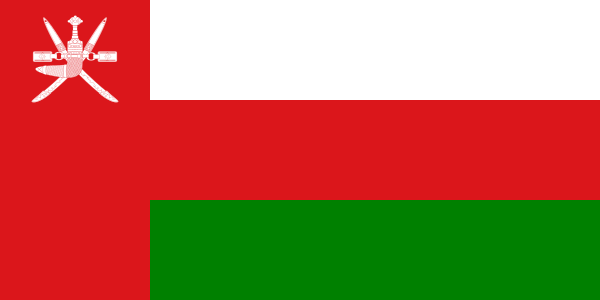
Oman is a country on the southeast coast of the Arabian Peninsula, with shorelines on the Arabian Sea and the Gulf of Oman and land borders with the United Arab Emirates, Saudi Arabia, and Yemen. Its capital is Muscat. Oman has long mattered because of its position at the mouth of the Persian Gulf, where sea routes between the Indian Ocean, the Gulf, and inland Arabia meet.
| Fact | Detail |
|---|---|
| Official name | Sultanate of Oman |
| Region | Southwest Asia, on the Arabian Peninsula |
| Capital | Muscat |
| Neighbouring countries | United Arab Emirates, Saudi Arabia, Yemen |
| Coasts | Arabian Sea and Gulf of Oman |
| Political system | Sultanate |
Why Oman matters
Oman sits at a geographic hinge. Control of the coast near the Strait of Hormuz has made it important to trade, navigation, and regional politics for centuries. Merchant networks linked Omani ports with East Africa, Iran, India, and the wider Indian Ocean world, and those connections left traces in architecture, language, food, and craft.
That strategic location also shaped the modern state. Oman has had to balance desert interiors with coastal cities, maritime exchange with inland tribal and agricultural traditions, and Gulf politics with a distinct historical identity. For designers and visual researchers, Oman is interesting not only as a place on a map but as a setting where climate, trade, and governance have shaped built form and material culture.
What does Oman look like on the ground?
Oman is not one landscape. The country includes long coasts, rocky mountain ranges, gravel plains, sand deserts, and fertile pockets where water can be managed through ancient irrigation systems. The Al Hajar mountains rise sharply in the north, while the Rub’ al Khali fringe and interior deserts give the country its widely recognised arid character.
In practice, that means settlement often clusters around water, shade, and sea access. Forts, walled towns, date plantations, mosques, and whitewashed urban buildings are common visual markers. The climate encourages thick walls, narrow streets, courtyards, and surfaces that handle heat and glare well. Coastal cities and inland oases can feel very different, even within the same governorate.
How history shaped Omani culture and craft
Oman’s history includes periods of seafaring power, local rule, and engagement with wider empires and trading systems. The country developed a strong maritime tradition, especially in shipbuilding and navigation, and Omani vessels were long associated with trade across the Indian Ocean. That movement of goods also carried ideas, decorative forms, and building practices.
Craft traditions remain visible in metalwork, textiles, pottery, palm-frond weaving, and woodwork. Silver jewellery, khanjars with ornate sheaths, and architectural details in carved doors or plasterwork are among the best-known objects associated with Omani culture. These are not museum pieces alone; many continue as living forms tied to ceremony, identity, and local production.
Why Oman appears in art, illustration, and travel imagery
Oman often attracts visual attention because it offers strong contrasts: pale desert light, dark rock, turquoise water, mud-brick settlements, and the clean geometry of forts and mosques. Travel photography and illustration frequently use these contrasts to express scale and stillness. The country can read as spare, monumental, and carefully maintained, even when the subject is an everyday street or marketplace.
Artists and illustrators working on Oman often lean on pattern, topography, and material surfaces rather than spectacle alone. That can mean rendering the folds of mountain strata, the repetition of palm trunks, or the crisp edges of civic and religious buildings. In design terms, Oman is a place where landscape and built environment are closely matched, so a convincing image usually depends on attention to both.
Frequently Asked Questions
Is Oman part of the Arabian Peninsula?
Yes. Oman occupies the southeast corner of the Arabian Peninsula. It also controls coastline along the Arabian Sea and the Gulf of Oman, which gives it a different orientation from some inland Gulf states.
What is Oman best known for?
Oman is known for its maritime history, desert and mountain landscapes, and a built environment that includes forts, old port cities, and oasis settlements. It is also associated with frankincense trade routes, traditional shipbuilding, and a more conservative but distinctly independent cultural identity within the Gulf.
Why is Muscat important?
Muscat is the capital and principal political centre of Oman. Its harbour location made it important for trade and naval power, and the city still anchors government, commerce, and national symbolism. Its architecture and coastal setting also make it one of the country’s most recognisable urban landscapes.
At a glance
- Address
- Oman
- Coordinates
- 23.6, 58.55
Articles mentioning Oman