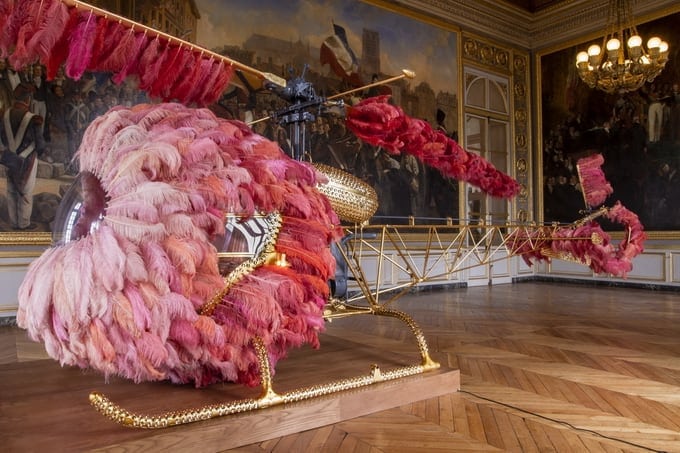
Joana Vasconcelos is a Portuguese contemporary artist known for large-scale installations, sculptural assemblages, and decorative interventions that use familiar domestic materials such as textiles, lace, ceramic tile, cookware, and LED lighting. Her work turns craft processes associated with the home into spectacle, often by enlarging them to monumental scale and placing them in museums, palaces, and public spaces.
| Fact | Detail |
|---|---|
| Born | 1971, Paris, France |
| Based in | Lisbon, Portugal |
| Known for | Installation, sculpture, textile-based construction, decorative assemblage |
| Materials | Fabric, crochet, embroidery, industrial metal, porcelain, plastic, household objects |
| International breakthrough | Venice Biennale, 2005 |
What does Joana Vasconcelos make?
Vasconcelos builds objects that sit between sculpture, craft, and interior decoration. A work may begin with a simple domestic form such as a chandelier, shoe, animal, or household utensil, then expand into something oversized and theatrical. She often covers structural frameworks with handmade surfaces, using crochet, quilting, beadwork, and other labor-intensive techniques that make the process visible.
This combination matters. The scale gives the work physical force, while the handmade surface carries associations with feminine labor, domestic routine, and ornament. Rather than separating fine art from craft, her work makes those categories collide in public.
Why is she important?
Vasconcelos gained wide international attention after the 2005 Venice Biennale, where her presence helped establish her within a global exhibition circuit that values work able to command large architectural spaces. Since then, her installations have appeared in major museums and historic sites, where their size and material excess create a direct visual impact.
Her importance also lies in how she repositions decorative practice. Crochet, lace, embroidery, and tile work are often treated as secondary or anonymous forms of production. Vasconcelos places them at the center of contemporary art and gives them the scale, budget, and institutional frame usually reserved for monumental sculpture.
How does her work look in practice?
A Vasconcelos installation often reads first as a single vivid mass. Up close, it breaks into many individual parts: stitched fabric, repeated modules, found domestic objects, metal supports, and surfaces that have been wrapped, attached, or coated by hand. The result can feel both celebratory and excessive, with a strong pull toward pattern, repetition, and accumulation.
She also uses contrast carefully. Heavy objects may be softened with textile, while fragile-looking forms may be built from industrial materials. That tension between hardness and softness, ornament and engineering, gives the work its distinct character.
Where does her visual language come from?
Vasconcelos draws on Portuguese visual culture, especially the value placed on ornament, ceramic surface, and domestic handiwork. The influence of azulejo tile patterning, lace, and craft traditions is clear, but she does not reproduce them as heritage objects. Instead, she scales them up, combines them with contemporary fabrication, and places them in contexts that change how they are read.
Her work also borrows from pop aesthetics and baroque display. Color, shine, repetition, and extravagance are central. Rather than aiming for restraint, she uses visual abundance as a method, making decoration itself the subject.
Frequently Asked Questions
Is Joana Vasconcelos a sculptor or an installation artist?
She works across both categories, but installation is often the most accurate description for her large projects. Many works involve sculptural construction, yet they are designed to occupy an entire room, courtyard, or building facade. The viewer experiences them as environments rather than isolated objects.
What materials does she use most often?
She frequently uses textiles, crochet, embroidery, ceramic tiles, cookware, plastic, and metal armatures. The exact material mix varies by project, but domestic and handmade materials recur throughout her practice. Those materials matter because they carry social meanings before they become art.
Why does her work use so much ornament?
Ornament is central to her method because it lets her elevate forms associated with domestic labor and craft. She uses decoration not as a finishing touch but as structure, surface, and meaning. In her work, ornament becomes a way to question which kinds of making art institutions have historically valued.
Articles mentioning Joana Vasconcelos