
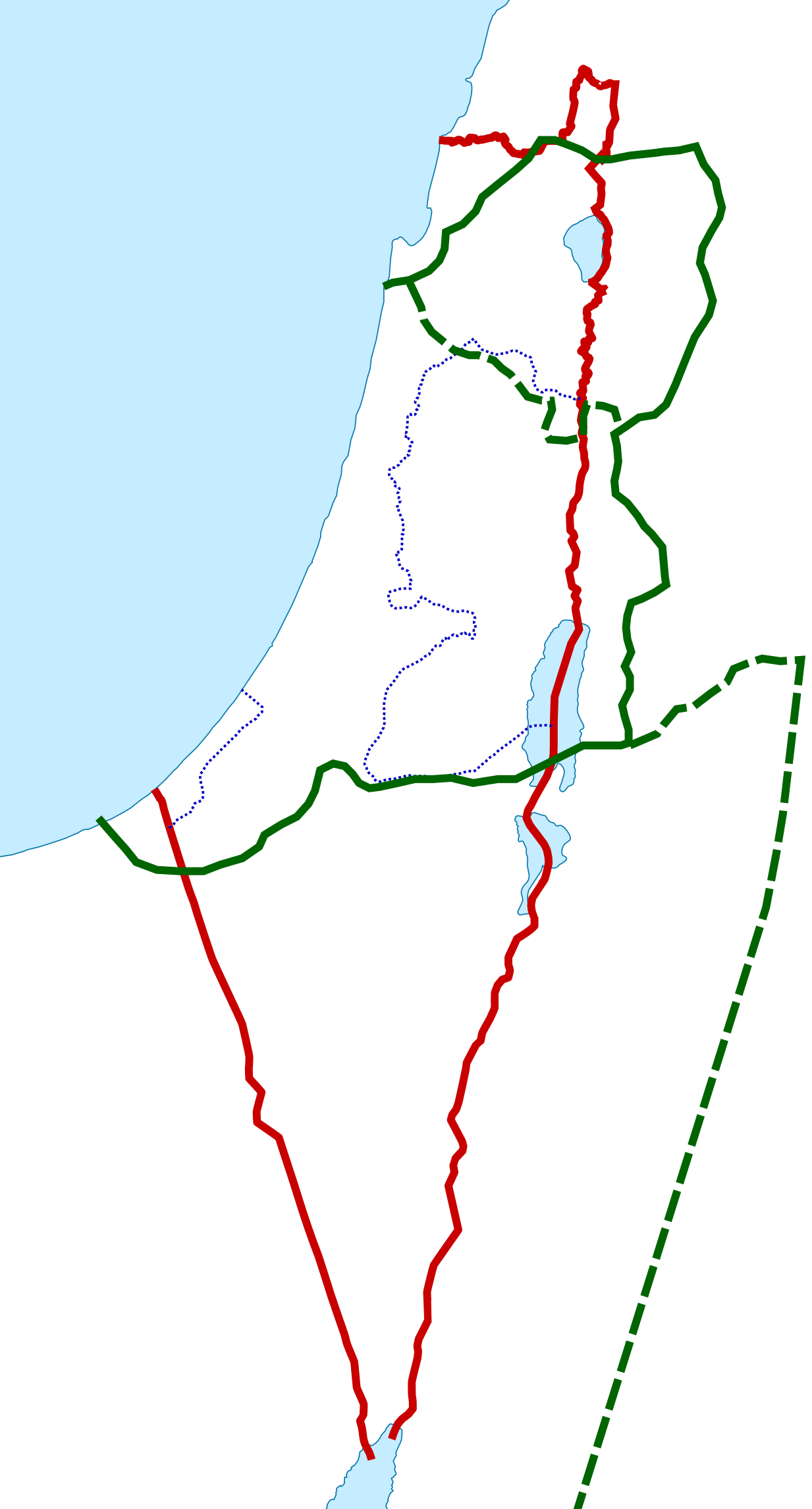
Palestine is a geographic and historical name for the land between the Mediterranean Sea and the Jordan River, together with adjacent areas whose boundaries have shifted across empires, administrations, and periods of local rule. The term has never referred to a single fixed state or border; it has been used for a region, a political claim, and a cultural homeland. In art and design writing, the name usually points to the lived landscapes, cities, villages, materials, and built environments of that region rather than to a neat map line.
- A regional name with ancient, biblical, imperial, and modern political histories.
- Used for territory that today includes Israel and the occupied Palestinian territories, though the name has meant different extents at different times.
- Appears in cultural writing when work is rooted in place, memory, displacement, heritage, or local craft traditions.
- Often connected to masonry, stonework, embroidery, ceramics, olive wood, and other material practices shaped by the region.
Where does the name come from?
The word Palestine comes through Greek and Latin from earlier names used for the region, and it has been attached to the area in different forms for many centuries. Ancient texts used several related regional names, including Canaan and Judea, while later imperial administrations applied broader labels such as Syria Palaestina. The modern English form entered common use through European writing and mapping, and it remained in circulation through the Ottoman, British Mandate, and contemporary periods.
Because the region has been governed by many powers, no single historical border defines the term. Writers, historians, and cartographers have used it in overlapping ways, sometimes to mean a narrow area around the southern Levant and sometimes to include much more. That shifting usage is part of why the name remains politically charged as well as geographically descriptive.
Why does Palestine matter in visual culture?
Palestine matters because place is central to how cultural objects are made, stored, and read. Architecture, ornament, and craft traditions from the region often carry traces of local stone, clay, textile techniques, agricultural life, and domestic use. In contemporary art and design, references to Palestine frequently engage with displacement, inheritance, lost archives, and the preservation of skills that survive through family and community rather than institutions.
The term also matters because naming itself can be an act of description, memory, or politics. A work described as Palestinian may be tied to people living in the West Bank, Gaza, East Jerusalem, within Israel, or in diaspora communities abroad. In each case, the label signals more than nationality; it often points to a history of movement, interruption, and continuity that affects how objects are made and how they are preserved.
What does it look like in practice?
In practice, Palestine appears through material traditions that are strongly place-specific. Palestinian embroidery, often called tatreez, uses counted stitching, regionally distinct motifs, and garments that once marked village identity, marital status, and ceremonial use. Stone carving, olive-wood carving, soap making in cities such as Nablus, and domestic ceramic work all belong to the region’s visual and material culture as much as any formal art movement does.
It also appears in contemporary projects that treat land as archive. Artists may work with clay, metal, textiles, or print to recall demolished houses, agricultural terraces, olive groves, or urban streetscapes. In those works, Palestine is not an abstract symbol; it is a set of surfaces, measurements, smells, and working methods shaped by everyday life under changing conditions of access, loss, and repair.
How should the term be understood today?
Today, Palestine can mean a cultural homeland, a political claim, a historical region, or a present-day territorial reference, depending on context. That flexibility makes the term useful in scholarship and art criticism, but it also demands care. A precise description should say whether the subject is the historic region, the Palestinian people, the State of Palestine, or a specific city or locality within the area.
For FreeYork, the most useful approach is material and contextual. When an artwork, exhibition, or maker is linked to Palestine, the relevant question is often how geography has shaped technique: which clay was used, which stitch pattern was inherited, which stones were cut, which plant dyes or olive woods were available, and which forms of making have been carried across borders or rebuilt after rupture.
Frequently Asked Questions
Is Palestine a country or a region?
It can be used as both, depending on context. Historically, it has named a region, while in contemporary politics it is also the name of the State of Palestine, a partially recognized state with claims to the West Bank and Gaza. In cultural writing, the term often refers to the broader historic and lived landscape rather than a legal definition alone.
Why do different maps use different names for the same area?
The region has been ruled and described by successive empires, colonial administrations, and modern states, each with its own naming conventions. As a result, maps may use Palestine, the Holy Land, the Southern Levant, Israel, Cisjordan, or other historical names depending on period and purpose. The choice of name often reflects political position as much as geographic convention.
What kinds of craft are most associated with Palestine?
Several practices stand out: embroidery, especially tatreez; stone carving; olive-wood carving; ceramics; and soap making. These are not the only traditions, but they are among the most visible in art, heritage, and design contexts. Many of them depend on local materials and on knowledge passed through families, workshops, and village networks.
At a glance
- Address
- Anderson County, United States
- Coordinates
- 31.758056, -95.638611
Articles mentioning Palestine


