Rio de Janeiro is a major Brazilian city and state capital on the Atlantic coast, known for its mix of steep mountains, beaches, colonial-era urban fabric, and dense modern neighbourhoods. It became one of the country’s most important cultural centres through its long life as a port city, then as Brazil’s national capital until 1960. Today it remains a global reference point for Carnival, popular music, photography, and the visual shorthand of Brazil itself.
| Country | Brazil |
|---|---|
| State | Rio de Janeiro |
| Region | Southeastern Brazil |
| Status | State capital; major metropolitan centre |
| Known for | Carnival, beaches, samba, modernist landmarks, mountain-and-sea setting |
| Urban character | High-density city spread between shoreline, hills, lagoons, and forested slopes |
Why Rio matters
Rio matters because it concentrates so many of Brazil’s public images in one place. The city’s landscape gives it a dramatic visual identity: Sugarloaf Mountain, the Corcovado ridge, the long arc of Copacabana and Ipanema, and the dense housing that climbs the surrounding hills. Those forms recur in painting, cinema, tourism photography, graphic design, and editorial illustration because they are instantly legible and unusually cinematic.
The city also matters as a cultural engine. Samba schools, street blocos, the city’s food markets, its studios, and its large art institutions have made Rio a site where performance and image-making meet. For designers and artists, it offers a study in contrast: formal architecture beside improvisation, monumental scenery beside packed domestic streets, and luxury beachfront culture beside informal settlements.
How did Rio de Janeiro develop?
Rio was founded by the Portuguese in the 16th century and developed first as a strategic harbour, then as an administrative and commercial centre. Its port linked the city to Atlantic trade, including the slave economy that shaped Brazil’s history and urban growth. In the 18th and 19th centuries, Rio became the centre of colonial and later imperial administration, which left behind layers of churches, civic buildings, and street plans that still shape the core city.
The city’s national role peaked when it served as Brazil’s capital until Brasília replaced it in 1960. That change shifted some political power inland, but Rio kept its cultural influence. The move also helped preserve a strong concentration of museums, theatres, publishing, and media institutions in the city, which continue to support its public image far beyond its administrative role.
What does Rio look like in practice?
Rio is not a single flat urban grid. It is built across beaches, lagoons, granite peaks, and steep slopes, so movement through the city often involves sudden changes in scale and texture. A beachfront avenue can sit minutes from a hillside favela, and a formal avenue may give way to narrow streets, tiled stairways, or forest edges. That spatial compression gives the city much of its visual energy.
In practice, Rio’s built environment mixes colonial churches, 19th-century civic buildings, mid-century apartment blocks, and modernist landmarks with informal housing and expressive street life. The city’s visual culture often depends on material contrast: painted concrete, ceramic tile, weathered stone, bright textiles, metal railings, and dense vegetation. Photographers and artists return to these surfaces because they register both glamour and strain without needing explanation.
What makes Rio a visual culture landmark?
Rio is one of the most reproduced cities in the world because it offers a clear and flexible iconography. The Christ the Redeemer statue, the cable car at Sugarloaf, beach promenades, and Carnival costumes all operate as symbols, but they are only part of the story. The city also carries a more complicated visual record: inequality, policing, self-built housing, urban marginality, and ecological pressure are all present in the same frame.
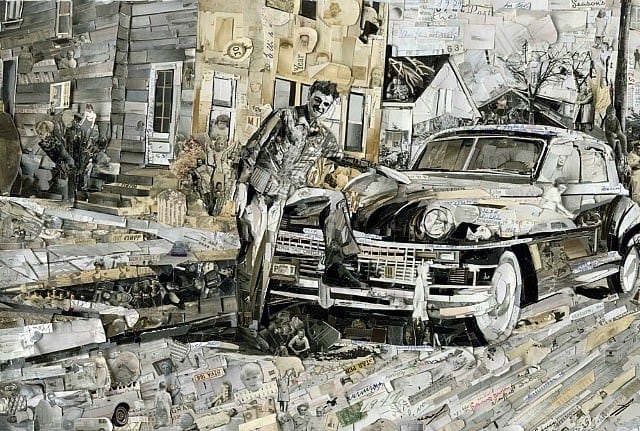
That complexity matters to visual culture because Rio resists a single clean image. A postcard view and a documentary photograph may show the same skyline but tell entirely different stories. Artists use the city to stage this tension between spectacle and reality, often through collage, manipulated photography, or dense observational work that makes the city’s layered surfaces visible.
Frequently Asked Questions
Is Rio de Janeiro the capital of Brazil?
No. Rio de Janeiro is the capital of the State of Rio de Janeiro, but Brazil’s national capital is Brasília. Rio was the federal capital until 1960, which is why it still carries such a strong political and institutional legacy.
That earlier status shaped the city’s museums, government buildings, and ceremonial spaces. It also helped establish Rio as one of Brazil’s most important cultural centres long after the capital moved.
Why is Rio so often used in art and photography?
Rio offers a rare combination of recognisable landmarks and dense everyday life. Its mountains, beaches, and monumental public sculpture create instantly readable images, while its neighbourhoods, street scenes, and hillside settlements give artists more complex material to work with.
That contrast makes the city useful for both iconic and critical representations. Many artists return to Rio when they want a scene that can hold beauty, urban pressure, and social contradiction at once.
What is Rio’s relationship to Carnival?
Rio’s Carnival is one of the city’s defining cultural events and a major reference point for its global identity. It brings together samba schools, costume making, floats, choreography, percussion, and long months of preparation. The event is as much an industrial and organisational system as a celebration.
For makers, Carnival matters because it depends on textiles, featherwork, metal structures, paint, and performance design. Its scale turns the city into a temporary stage, with neighbourhood labour and local craftsmanship visible in public form.
At a glance
- Address
- Rio de Janeiro, Brazil
- Coordinates
- -22.905392, -43.177128
Articles mentioning Rio de Janeiro