
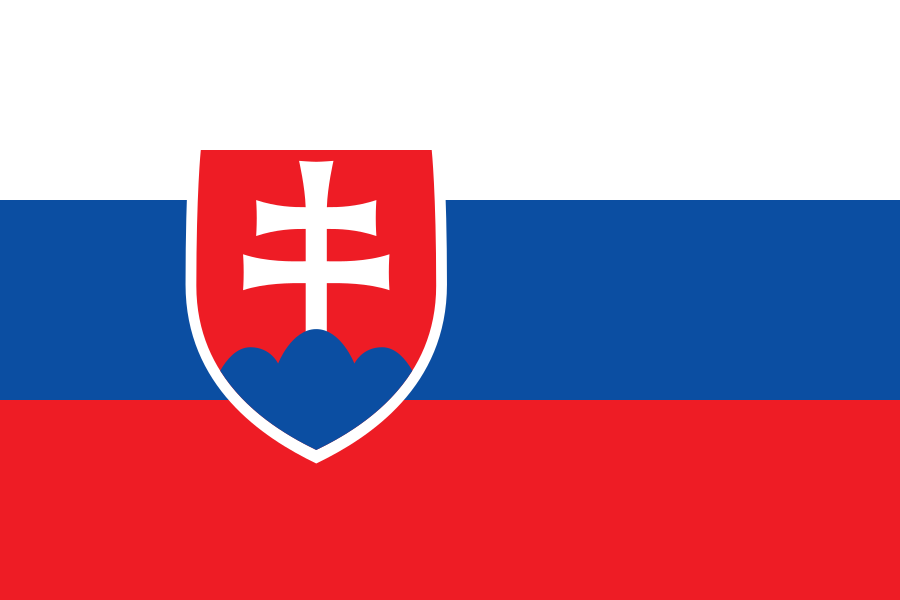
Slovakia is a landlocked country in Central Europe, known for its medieval towns, mountain landscapes, and strong industrial and craft traditions. It became an independent state in 1993 after the peaceful split of Czechoslovakia, with Bratislava as its capital and largest city. Its built environment ranges from dense historic centres and socialist-era housing estates to newer commercial districts, and those layers of architecture often show up in photography, urban design, and restoration projects.
| Fact | Details |
|---|---|
| Official name | Slovak Republic |
| Capital | Bratislava |
| Largest city | Bratislava |
| Region | Central Europe |
| Independence | 1993 |
| Bordering countries | Czech Republic, Austria, Poland, Ukraine, Hungary |
| Government | Parliamentary republic |
Where is Slovakia and what makes it distinct?
Slovakia sits at a crossroads between the Danube basin and the Carpathian Mountains. Its position has shaped trade, settlement, and architecture for centuries. The west of the country connects closely with Vienna and the wider Central European corridor, while the east has stronger links to the historic towns and industrial centres that grew under Habsburg, Hungarian, and later Czechoslovak rule.
That geography matters in visual culture because it produces sharp contrasts in scale and texture. Bratislava has a compact old town, postwar housing blocks, and contemporary redevelopment. Košice, the second-largest city, combines a preserved historic core with large industrial and residential districts. Outside the cities, villages, forests, ski areas, and castle ruins create a landscape that photographers often frame as orderly, atmospheric, and slightly cinematic.
How did Slovakia emerge as a modern state?
The modern state of Slovakia emerged from the long break-up of older political formations in Central Europe. For much of the 20th century it was part of Czechoslovakia, a state formed after the First World War and remade after the Second. Slovak national identity grew through language, literature, and cultural institutions, but political sovereignty arrived only in 1993, when Czechoslovakia dissolved peacefully into the Czech Republic and Slovakia.
That history still shapes how the country is seen. Many buildings, transport systems, and housing estates date from the socialist period, when standardised construction and prefabricated concrete panels changed the appearance of cities across the region. At the same time, the country preserved a dense network of castles, churches, mining towns, and vernacular wooden architecture, so older forms remain visible alongside modern infrastructure.
What does Slovakia look like in practice?
Slovakia’s visual identity is often built from materials and systems rather than one dominant style. In cities, this means stone paving, stucco facades, brick industrial buildings, concrete housing blocks, glass-fronted offices, and renovated dormitories or apartment houses. In the countryside, timber, slate, plaster, and pitched roofs appear more often, especially in traditional settlements and mountain regions.
For designers, photographers, and architects, that mix creates a useful range of subjects. A socialist dormitory converted into apartments in Košice, for example, shows how inherited concrete structures can be adapted for contemporary living without erasing their mass and rhythm. Likewise, road trips through the country often pass from rigid planning grids to open rural landscapes very quickly, which gives Slovak locations a strong sense of contrast and movement.
Why does Slovakia matter in European culture?
Slovakia matters because it occupies a central position in Europe without being flattened into a single image. It is part of the European Union, NATO, the OECD, the United Nations, and the World Trade Organization, but it also retains local traditions that remain legible in craft, clothing, architecture, and public space. That combination makes it a frequent setting for stories about transition: from socialism to market economy, from older industry to service economies, and from inherited housing stock to adaptive reuse.
In visual terms, Slovakia is especially useful when a project needs believable texture. The country can read as pragmatic, slightly austere, and highly structured, yet it also offers decorative historic centres, mountain scenery, and a strong regional identity. For publications focused on how things are made, that means Slovakia is not just a backdrop. It is a place where materials, planning, and history remain visible on the surface.
Frequently Asked Questions
Is Slovakia the same as Czechoslovakia?
No. Czechoslovakia was a larger state that existed in the 20th century and included both Czech and Slovak lands. Slovakia became fully independent in 1993 when Czechoslovakia split peacefully. The two countries remain close culturally and economically, but they are separate states.
What kind of architecture is common in Slovakia?
Slovakia has a broad mix of architecture, from medieval town centres and baroque churches to socialist housing estates and contemporary renovation projects. Prefabricated concrete apartment blocks are especially visible in cities and suburbs, while smaller towns and villages often preserve timber houses and historic civic buildings. That mix gives the country a layered, highly legible urban landscape.
Why does Slovakia appear often in photography and travel features?
Slovakia offers strong visual contrasts in a compact area: mountains, industrial suburbs, historic towns, and formal urban housing are all close together. This makes it attractive for photographers looking for clear structure, repetition, and atmosphere. Its Central European setting also gives it a recognisable but less overexposed character than some neighbouring destinations.