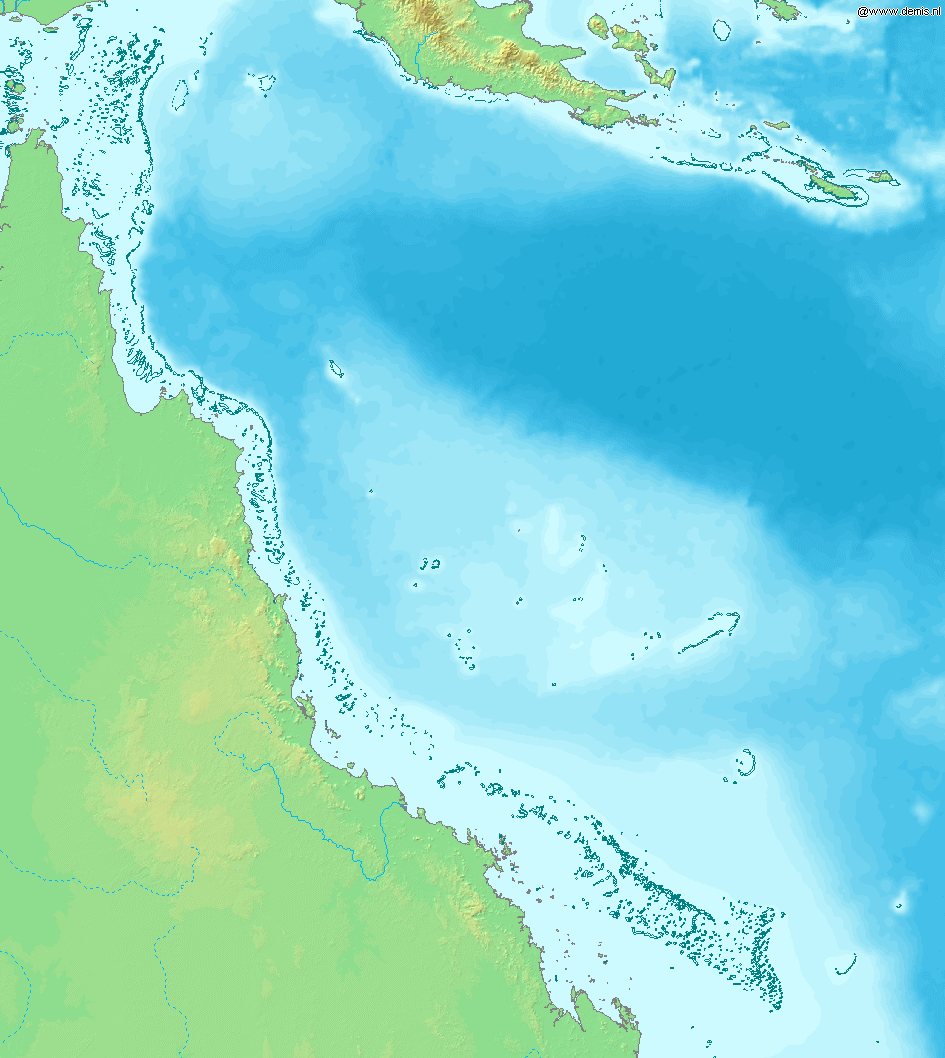
The Great Barrier Reef is a vast coral reef system off Queensland, Australia, made up of thousands of reefs, cays, and islands built by living coral over time. It runs for more than 2,300 kilometres along the Coral Sea coast and is the largest coral reef system on Earth. Its scale, biological richness, and visible reef structures have made it one of the best-known places in marine science and travel writing.
- It is not one reef but a linked system of reefs, lagoons, and islands.
- Living coral polyps build the framework by secreting calcium carbonate skeletons.
- It supports an unusually dense mix of fish, molluscs, turtles, seabirds, and marine mammals.
- Bleaching, warming seas, pollution, and cyclones have damaged parts of the reef in recent decades.
- It is both a natural landmark and a heavily studied cultural and environmental site.
What is the Great Barrier Reef made of?
The Great Barrier Reef is made by coral polyps, small animals that live in colonies and build hard limestone skeletons. Over long periods, those skeletons accumulate into reef structures that create shallow platforms, channels, bommies, and reef edges. The system also includes sand cays, mangrove-fringed islands, and seagrass beds, so the reef is a landscape rather than a single continuous wall.
This construction depends on a close partnership between coral and symbiotic algae called zooxanthellae, which help corals grow by providing energy through photosynthesis. Because of that relationship, the reef is tightly tied to clear, warm, sunlit water. Its colours come from both the coral tissue and the organisms that live within and around it, which is why aerial views show patches of turquoise, blue, green, and brown rather than one uniform surface.
How did it form?
The reef system developed over hundreds of thousands of years, with its present form shaped after the last ice age, when rising sea levels flooded the continental shelf off Queensland. As the shoreline moved and conditions changed, coral colonies established themselves on older limestone foundations and kept building upward and outward. The result is a layered system that records both geological change and biological growth.
Its position along a broad tropical shelf matters. The shallow waters provide enough light for coral growth, while currents and tidal movement bring nutrients and disperse larvae. Different parts of the reef have different ages and compositions, which is why some sections form compact fringing reefs near the coast while others appear as isolated coral outcrops separated by channels and open water.
Why does the Great Barrier Reef matter?
The reef matters because it is an ecological engine. It provides habitat, feeding grounds, and breeding sites for thousands of species, including clownfish, parrotfish, sharks, rays, dugongs, green turtles, and seabirds. Many species depend on the reef for only part of their life cycle, so damage to one area can affect larger marine networks.
It also matters as a measure of environmental stress. Coral bleaching, caused when heat pushes corals to expel the algae they depend on, has become one of the clearest signs of ocean warming. Scientists study the reef not only for its biodiversity but also for what it reveals about climate change, water quality, and resilience in living systems. For coastal communities, tourism, fishing, and Indigenous cultural connections make the reef part of daily life as well as global heritage.
What does it look like in practice?
On the surface, the reef can look like scattered patches of colour in a broad blue sea; underwater, it becomes a dense architectural field of branching, plate-like, and boulder corals. Some areas have delicate staghorn forms that resemble antlers, while others show rounded brain corals or flat table corals that stack like shelves. Visibility, depth, and coral health all change the look of a site, so no single image captures the whole system.
In practice, the reef is also a working environment. Divers, marine biologists, boat crews, tourism operators, and Traditional Owners move through it using charts, moorings, monitoring stations, and seasonal knowledge. Management includes zoning, anchoring controls, reef restoration trials, and water-quality programs. That mix of natural form and human intervention is part of how the reef is experienced today.
Frequently Asked Questions
Is the Great Barrier Reef one continuous structure?
No. It is a connected system of reefs, islands, and cays spread across a large area of the Coral Sea. The parts vary in depth, shape, and age, and many are separated by channels or open water. That patchwork structure is why the reef can support so many different habitats.
Why do corals bleach?
Corals bleach when stress, especially unusually warm water, causes them to expel the algae that live in their tissues. Without those algae, the coral loses colour and much of its energy source. Bleaching does not always kill coral, but repeated or severe events can leave reefs weakened or dead.
Can the Great Barrier Reef still be seen from space?
Yes, large parts of the reef system are visible from space because of its scale and the contrast between shallow reef flats and deeper ocean water. That visibility has helped make it a symbol of natural abundance. It also means changes in colour and reef cover can be tracked over time using satellite imagery.
At a glance
- Address
- Queensland, Australia
- Coordinates
- -18.286112, 147.7
Articles mentioning Great Barrier Reef