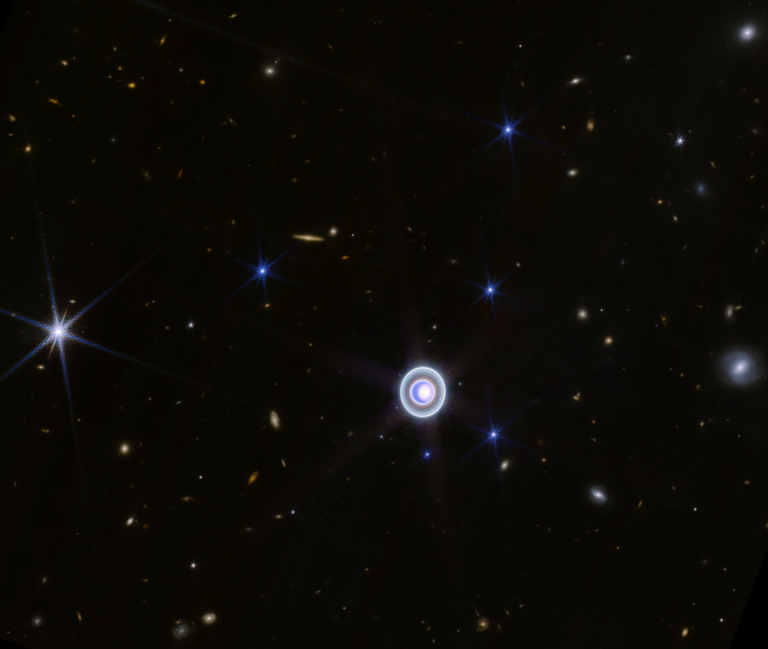
Uranus is the seventh planet from the Sun, an ice giant with a pale blue-green atmosphere, faint rings, and a highly tilted axis that makes it appear to roll around the Sun on its side. It is one of the Solar System’s outer planets, made mostly of hydrogen, helium, water, ammonia, and methane rather than rock or metal alone.
- Uranus is an ice giant, not a gas giant like Jupiter or Saturn.
- Its axis is tilted by about 98 degrees, giving it extreme seasonal behavior.
- Methane in the upper atmosphere absorbs red light and gives the planet its blue-green color.
- It has a narrow ring system and at least 27 known moons.
- Only one spacecraft, Voyager 2, has visited it up close.
What makes Uranus different from other planets?
Uranus stands out because of its unusual orientation. Instead of spinning upright, it rotates on its side, so its poles take turns facing the Sun for long stretches. That tilt shapes the planet’s seasons, weather, and light levels in ways no other major planet experiences so strongly.
Its interior also sets it apart. Scientists classify Uranus as an ice giant because a large share of its mass is made up of hot, dense “ices” such as water, ammonia, and methane under extreme pressure. A small rocky core likely sits at the center, surrounded by thick layers of fluid and gas.
Where did Uranus come from?
Uranus was discovered in 1781 by William Herschel, who first thought it might be a comet or a star before its motion showed it was a planet. It was the first planet found with a telescope rather than by naked-eye observation, which expanded the known boundaries of the Solar System and changed astronomy’s map of the heavens.
The planet was later named Uranus after the ancient Greek sky deity, following a naming pattern that linked the planets with classical mythology. For a time, it was also called Herschel in honor of its discoverer, but Uranus became the standard name.
What does Uranus look like in practice?
Through a telescope, Uranus appears as a small, smooth disc with a muted blue-green tint. That color comes from methane in the upper atmosphere, which absorbs red wavelengths and leaves the reflected light skewed toward blue and green. Unlike Jupiter, it shows little obvious banding to the eye, so its surface can seem quiet even though the atmosphere is active.

Closer views from Voyager 2 revealed thin rings, a few cloud features, and a system of moons with names drawn from Shakespeare and Alexander Pope. The planet’s rings are dark and narrow, and its moons range from heavily cratered bodies to more varied worlds with icy surfaces. The overall visual effect is restrained rather than dramatic, but the science beneath it is complex.
Why does Uranus matter?
Uranus matters because it fills a gap in planetary science between the small rocky inner worlds and the larger gas giants. Its composition, temperature, magnetic field, and sideways rotation all raise questions about how planets form and evolve. It also gives scientists a comparison point for the many icy exoplanets now being found around other stars.
Only one spacecraft has visited Uranus, and that single flyby left many questions open. Future missions could study its atmosphere, rings, moons, and internal structure in greater detail. For now, Uranus remains one of the least understood major planets in the Solar System.
Frequently Asked Questions
Is Uranus a gas giant?
Not exactly. Uranus is usually described as an ice giant because it contains a large proportion of water, ammonia, and methane in dense internal layers. Gas giants like Jupiter and Saturn are dominated more by hydrogen and helium.
Why is Uranus blue-green?
Methane in the upper atmosphere absorbs red light from the Sun. The remaining reflected light gives the planet its blue-green color. Small changes in haze and atmospheric composition can shift the exact shade.
Has Uranus ever been visited by a spacecraft?
Yes. Voyager 2 flew past Uranus in 1986 and remains the only spacecraft to have visited the planet at close range. That flyby provided the main source of detailed images and measurements still used today.
Articles mentioning Uranus