Lady Gaga is the stage name of Stefani Joanne Angelina Germanotta, an American singer, songwriter, performer, actor, and fashion-driven public figure whose work combines pop music with theatrical staging, costume, and image-making. She emerged from New York City’s Lower East Side scene in the mid-2000s and built a career around live performance, visual provocation, and constant reinvention.
| Born | March 28, 1986, New York City, United States |
|---|---|
| Known for | Pop music, performance art, fashion spectacle, screen acting |
| Early training | Convent of the Sacred Heart; briefly attended NYU’s Tisch School of the Arts |
| Breakthrough period | Late 2000s, after performing in Manhattan clubs and developing a theatrical pop persona |
| Associated industries | Music, fashion, film, beauty, celebrity branding |
Why Lady Gaga became a reference point
Lady Gaga matters because she helped define a version of pop stardom in which the song, the image, and the persona carry equal weight. Her early singles arrived with a precise visual language: sculptural hair, sharp tailoring, mirrored surfaces, latex, sequins, and a taste for costumes that looked closer to art direction than casual dress. That approach made her an unusually useful figure for photographers, stylists, and designers, who found in her a subject willing to use clothing and pose as part of the work itself.
Her public career also shifted how mainstream fame could be managed. Instead of treating fashion as a promotional accessory, she used it as a core medium, often collaborating with photographers, makeup artists, milliners, and designers to produce images that circulated as cultural events. That is why she appears so often in fashion editorials, portrait series, and celebrity culture archives: her identity is built through visual production as much as through music.
Where did Lady Gaga come from?
Germanotta grew up in Manhattan and studied at the Convent of the Sacred Heart before briefly enrolling at NYU’s Tisch School of the Arts. She left university to pursue music full time and began performing in the downtown club circuit, where rock, cabaret, and art-pop often overlap. That scene shaped her early sense of performance: not polished celebrity first, but a live act that borrowed from glam rock, burlesque, club culture, and performance art.
Her stage name came later, after she had already started building a persona around exaggerated gestures, dramatic silhouettes, and a strong sense of authored self-presentation. The Lady Gaga character was never only about a voice or a look; it functioned as a platform for control. It let her move between dance-pop, balladry, activism, and acting without collapsing into a single category.
What does Lady Gaga look like in practice?
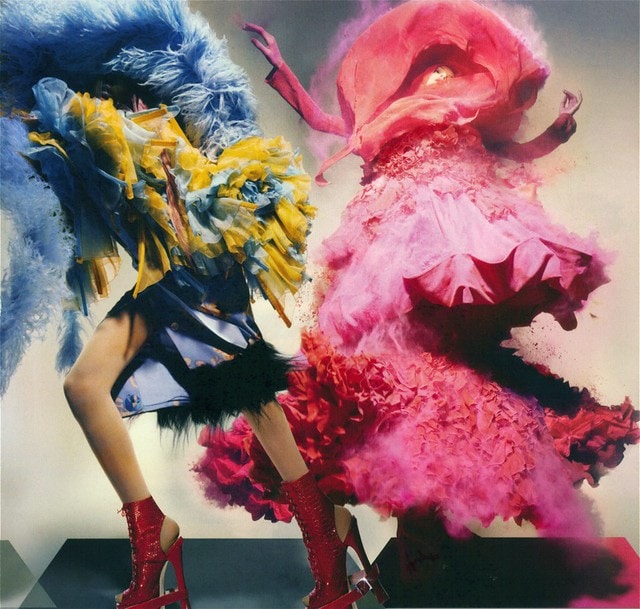
In practice, Lady Gaga’s work appears as highly constructed spectacle. That can mean a meat dress, a sculpted headpiece, a tailored latex look, or a performance staged like a moving tableau. The point is not shock for its own sake. The point is that garments, makeup, posture, and lighting are used with the same seriousness as melody and lyric.
This makes her especially important to visual culture. Photographers such as Nick Knight and Steven Klein have used her image to explore gloss, distortion, fetish texture, and hyper-controlled glamour. In editorial settings, she often reads less like a conventional celebrity subject and more like a collaborator in image production, someone whose body and wardrobe are treated as material for composition.
Why does she matter beyond music?
Lady Gaga’s influence extends into fashion, beauty, and celebrity branding because she made an identity out of transformation. She has shifted from maximalist pop spectacle to stripped-back performances, from club-floor volatility to Oscar-season elegance, and from theatrical provocation to intimate, emotionally direct acting roles. Each shift has been legible because her audience expects her image to be deliberate.
That flexibility has made her useful to publications and makers interested in how fame is styled. She is a frequent reference point for portrait artists, costume designers, and photographers because her public image carries clear visual signals: control, excess, vulnerability, and design literacy. Her career shows how celebrity can function as a made object, assembled from wardrobe, choreography, lighting, and self-mythology.
Frequently Asked Questions
Is Lady Gaga primarily a musician or a fashion figure?
She is primarily a musician, but fashion is central to how her music has been presented and understood. Her clothing, makeup, and staging often operate as part of the same artistic system as the songs. That is why she is discussed in both music writing and fashion coverage.
Why do photographers keep working with her?
She brings a strong visual identity to a shoot and understands how to use pose, costume, and expression as part of the image. For photographers, that creates room for formal experimentation rather than straightforward portraiture. Her presence often turns a photo session into a constructed scene.
What is distinctive about her early career?
Her early career grew out of New York’s downtown performance culture rather than a simple teen-pop pipeline. She combined club performance, art-school ambition, and a deliberate sense of character design. That background gave her work a more theatrical and self-conscious visual language from the start.
Articles mentioning Lady Gaga